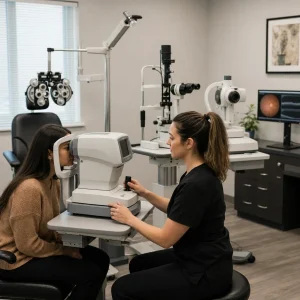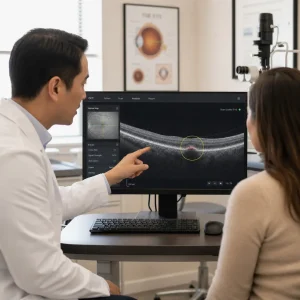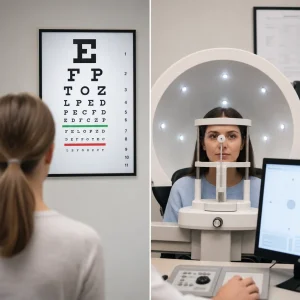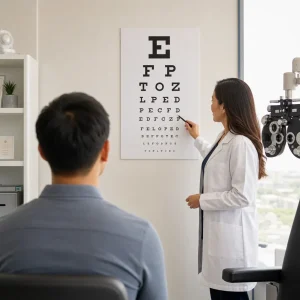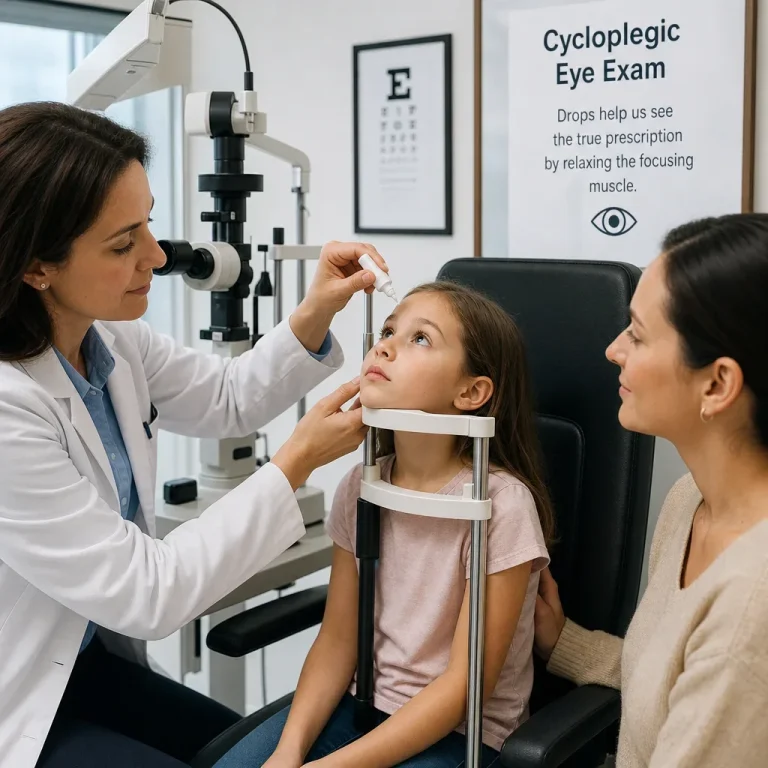
A cycloplegic refraction exam is not the same as a routine vision check. It uses medicated eye drops to temporarily relax the eye’s focusing muscle so the prescription can be measured more accurately, especially when active focusing may hide the real refractive error.
In one sentence: A cycloplegic refraction exam uses eye drops to switch off focusing for a short time so an optometrist can get a clearer prescription measurement.
What Is a Cycloplegic Refraction Exam?
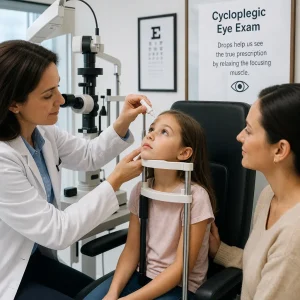
A cycloplegic refraction is a refraction done after special drops relax the ciliary muscle, which is the muscle the eye uses to focus up close . That is why people asking what is cycloplegic refraction, what is a cycloplegic test, or what is cycloplegic examination are usually talking about the same core idea: measuring glasses power after accommodation is reduced.
The main goal is more accurate prescription testing when normal focusing effort may mask farsightedness, mimic nearsightedness, or make results jump around from one reading to the next . The drops often enlarge the pupils too, but pupil dilation is not the main reason this test is ordered.
Licensed optometrists can perform cycloplegic refraction as part of a comprehensive eye exam when it is clinically indicated . In a Waterloo clinic setting, it is one possible part of an exam, not something every child or adult automatically needs.
What Does a Cycloplegic Test Check For?
A cycloplegic test checks whether active focusing is hiding the true prescription . It is especially useful for measuring hyperopia, myopia, astigmatism, and differences in prescription between the two eyes when standard testing is not giving a reliable baseline.
It can also help the optometrist assess patterns that fit pseudomyopia, accommodative spasm, or vision complaints that do not match the patient’s chart performance . A child can read small letters well and still be over-focusing to compensate for hidden farsightedness.
The test may support the assessment of amblyopia risk, anisometropia, or some forms of eye turn such as accommodative esotropia, because those concerns can be linked to unmasked refractive error . It does not diagnose every eye disease on its own, and the results have to be interpreted with the rest of the eye exam.
Why Eye Doctors Use Cycloplegic Refraction Instead of a Standard Refraction
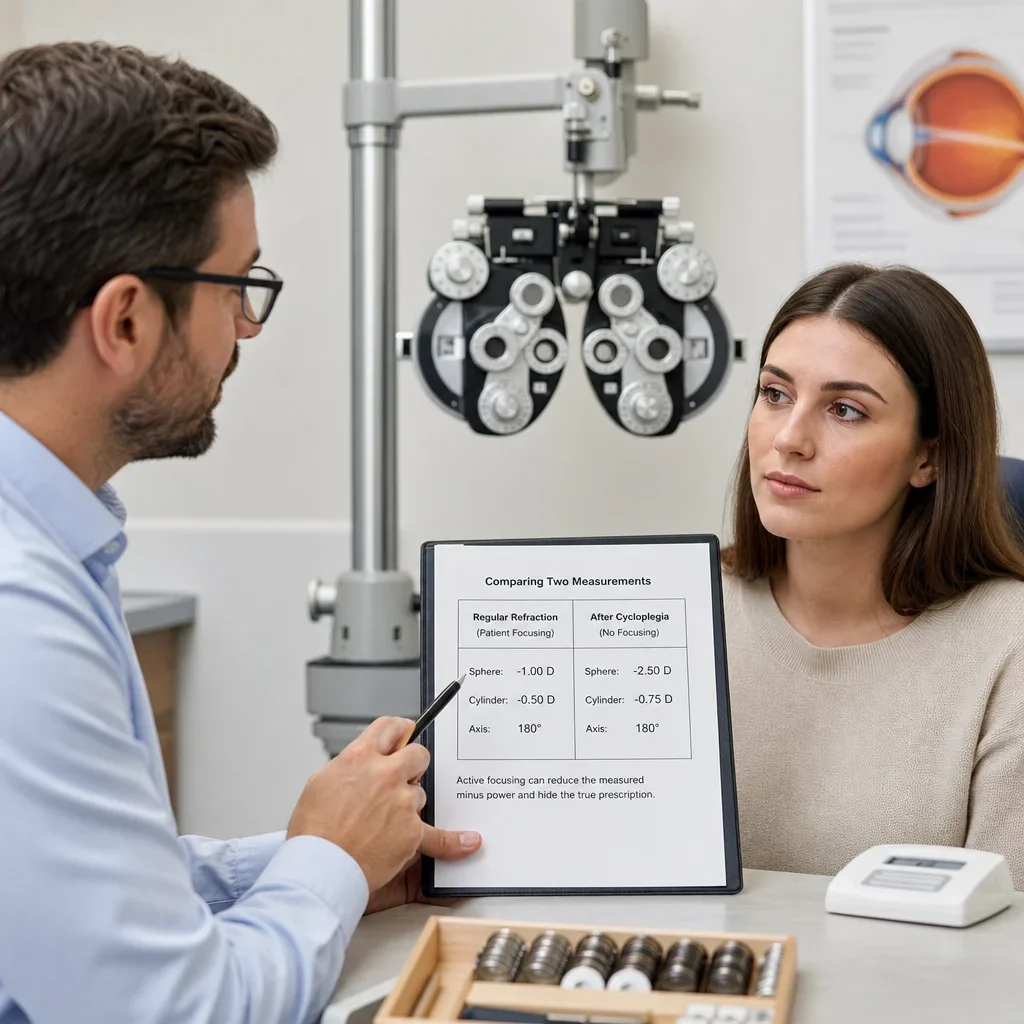
Standard refraction can be misleading when the eyes are still trying to focus during the test . Children, teens, and some young adults can accommodate strongly enough to blur the true starting point of the prescription.
That matters because accommodation can hide hyperopia or create a reading that looks more myopic than the patient really is . In plain English, the eye can “help too much,” and that can make the glasses measurement less accurate.
This is one reason a child with headaches, reading strain, intermittent blur, or a first-time glasses assessment may be asked to have a cycloplegic refraction exam . The goal is a cleaner baseline before decisions are made about glasses or follow-up care.
Cycloplegic refraction is a tool, not a default step for every patient . The optometrist decides based on age, symptoms, visual behaviour, and whether the routine refraction appears reliable.
Cycloplegic Refraction vs Regular Dilation Exam
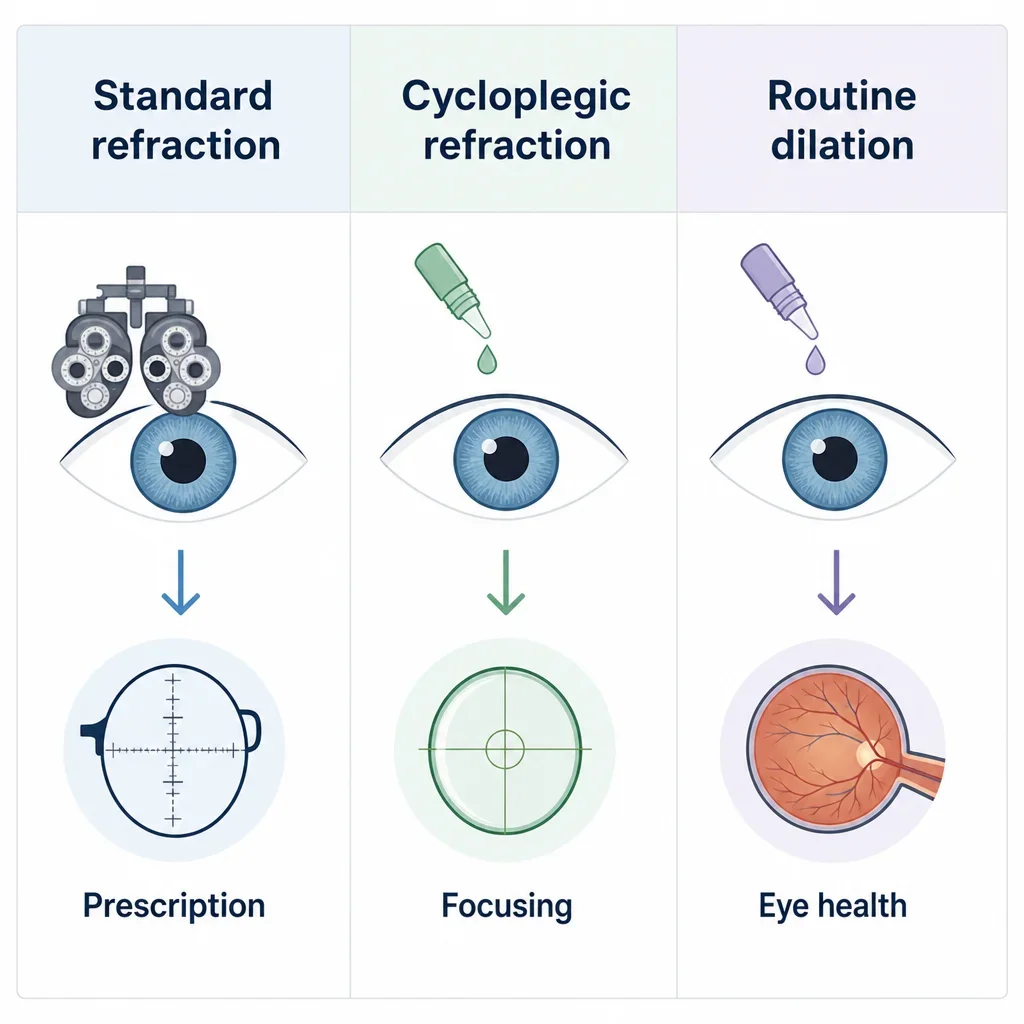
Cycloplegic refraction, standard refraction, and routine dilation overlap, but they are not interchangeable tests .
| Test | Main purpose | What the drops do | What the optometrist is trying to learn |
|---|---|---|---|
| Standard refraction | Measure glasses prescription without cycloplegic drops | Usually no cycloplegic effect | Your best lens power during a routine exam |
| Cycloplegic refraction | Measure prescription after accommodation is relaxed | Relaxes focusing and usually enlarges pupils | Your underlying refractive error with less interference from focusing |
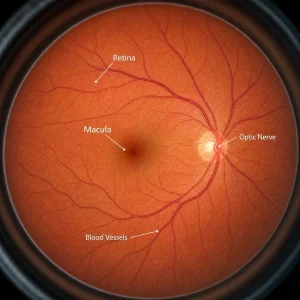
| Routine dilation exam | View internal eye structures more clearly | Enlarges pupils, depending on the drops used | Eye health findings involving the retina, optic nerve, and other internal structures |
Both cycloplegic testing and routine dilation may cause light sensitivity and blurred near vision for a while . The difference is the reason for using drops: one is mainly for accurate refraction, and the other is mainly for examining eye health.
That is why you should not assume that “dilation” and a cycloplegic refraction exam mean the same visit component . Sometimes both can happen in one appointment, but they answer different clinical questions.
Who Usually Needs a Cycloplegic Refraction?
Children are the group most often considered for cycloplegic refraction when hidden farsightedness or unstable focusing may affect the prescription . This comes up with suspected hyperopia, an eye turn, lazy-eye risk, large swings in measurements, headaches, or reading complaints.
A child may need it at a first eye exam if the optometrist wants a more dependable baseline before prescribing first glasses . That is especially relevant when the child’s symptoms and chart results do not line up neatly.
Some children can see well on the eye chart and still need this test because chart vision alone does not rule out accommodative effort or uncorrected hyperopia . Good distance letters do not always mean the prescription is simple.
Teens and adults can need cycloplegic refraction adults testing too, especially with pseudomyopia, accommodative spasm, fluctuating prescriptions, heavy near-work strain, or symptoms that seem out of step with a routine refraction . Adults are less likely than children to need it, but it remains a useful option in selected cases.
There is no one-size-fits-all age rule that should be applied from a blog post . The decision is individualized by the examining optometrist.
What Happens During the Cycloplegic Refraction Procedure?
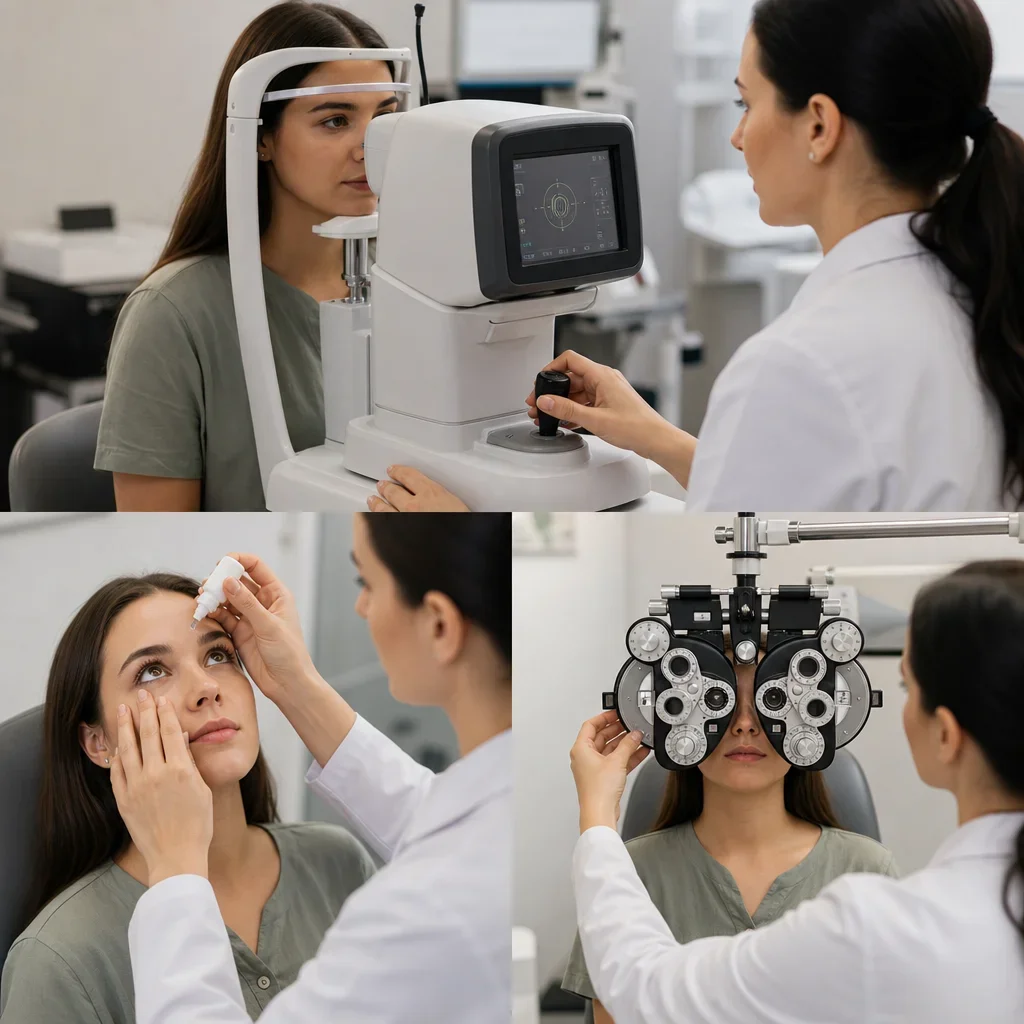
The cycloplegic refraction procedure usually starts with history, symptoms, and baseline testing before any drops are used . The optometrist may check visual acuity, eye alignment, focusing, and a preliminary prescription first.
The drops are then placed in the eyes, followed by a waiting period so they can take effect . The exact timing depends on the drop chosen and the clinical goal, so clinics should give the timeframe they use for that visit rather than a generic promise.
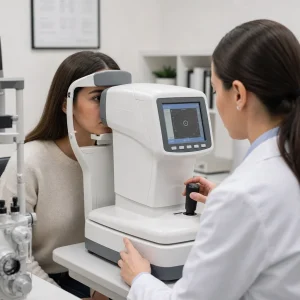
Once the focusing system is relaxed, the optometrist measures the prescription again using methods such as retinoscopy, an autorefractor, a phoropter, or a trial frame . Retinoscopy is an objective way of estimating prescription by observing how light reflects from the eye.
Children who cannot read letters can still be tested with picture matching, fixation targets, or objective techniques that do not rely on reading . That is one reason pediatric exams can still be accurate even when the child is too young for a standard eye chart.
The visit ends with a discussion of the cycloplegic refraction results and whether glasses, monitoring, or another follow-up step makes sense . If your family is booking a comprehensive eye exam in Waterloo, it helps to know this part of the visit can add waiting time because the drops need time to work.
Does It Hurt? What the Drops Feel Like
Most patients describe a cycloplegic test as a brief sting or irritation, not significant pain . The uncomfortable part is usually short.
Children may dislike the drop itself more than the exam that follows . They may also notice brightness or blurry near vision afterward, which can feel strange even when it is expected.
A reassuring explanation helps more than saying it feels like nothing . If a child is anxious, the team can usually explain each step in simple language before the drops go in.
What Eye Drops Are Used, and How Long Do They Last?

Cycloplegic exams commonly involve drops such as cyclopentolate or tropicamide, depending on the patient and the clinical goal . The exact drop choice is made by the examining doctor.
These drops temporarily relax accommodation and often make the pupils larger at the same time . That combination is why near vision may blur and bright light may feel stronger after the exam.
How long cycloplegic eye drops last depends on the specific medication, the person’s response, and the reason the drops were chosen . Because duration varies by drop and patient, it is better to expect temporary effects that may last for several hours and, in some cases, longer into the same day or next day rather than assume one exact timeline.
Questions such as “what are examples of cycloplegic drugs” or “what is the strongest cycloplegic drug” are medication questions that should be answered by the treating optometrist in the context of age, health history, and exam purpose . For patient education, the key point is that drop selection is clinical, not one-size-fits-all.
Common Side Effects and Rare Warning Signs
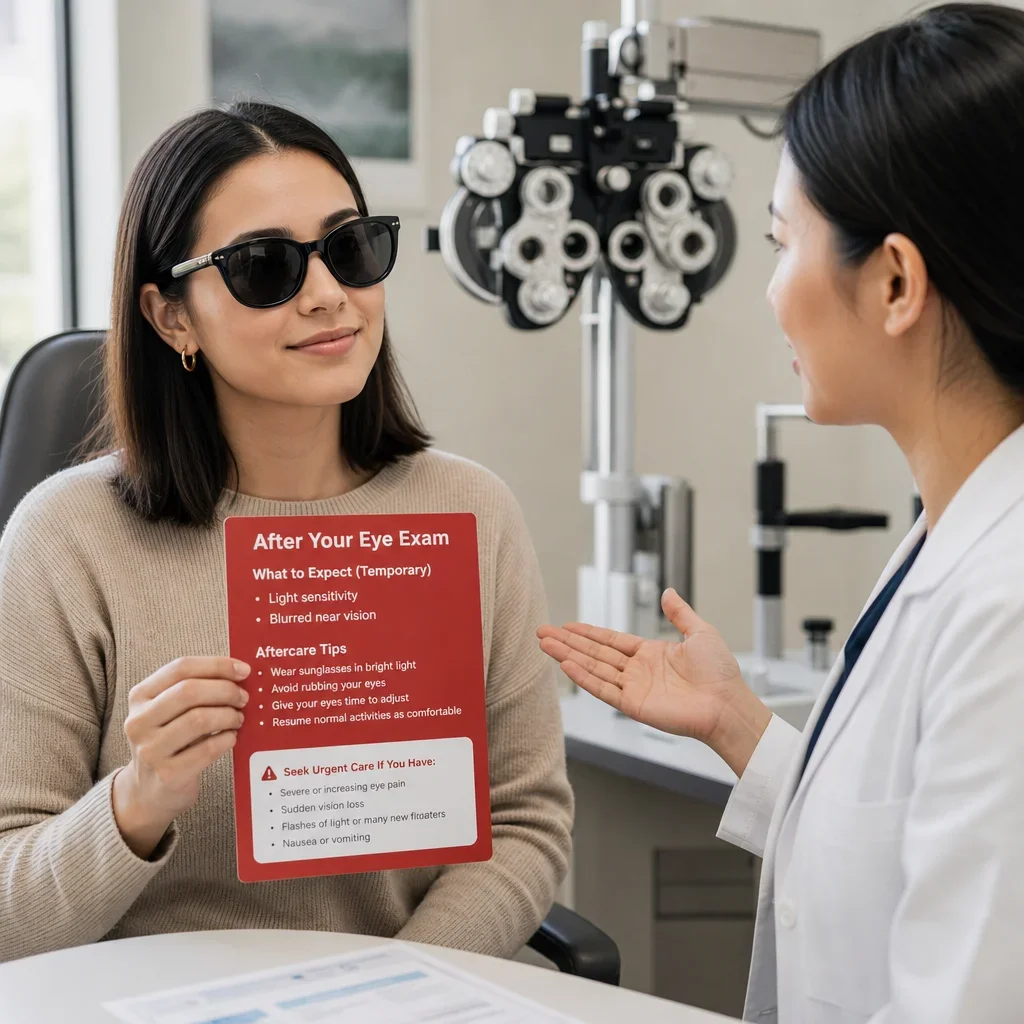
The most common side effects of cycloplegic eye drops are light sensitivity, blurred near vision, larger pupils, and mild temporary irritation or watering . Those effects are expected and usually settle as the drops wear off.
What is not expected is severe pain, marked redness, vomiting, a dramatic decline in vision, or symptoms that seem to be getting rapidly worse instead of better . Those are the kinds of changes that should prompt urgent contact with the clinic or immediate medical attention.
A short red-flag checklist is useful after any cycloplegic test:
- severe eye pain
- significant redness that keeps increasing
- vomiting or feeling acutely unwell after the drops
- sudden worsening of vision beyond the expected blur
- any unusual reaction that the clinic told you to watch for
Most patients do not have a serious reaction, but aftercare instructions matter because the drops temporarily change how the eyes feel and function . If you have questions about medications, allergies, or past reactions to eye drops, raise them before the exam.
How to Prepare Before the Appointment
Bring current glasses, any recent prescription information, and sunglasses for the trip home . If the clinic offers direct insurance billing, bring the plan details so the front desk can confirm what they need from you.
Ask the clinic in advance whether contact lenses should be left out before the appointment . Lens wear can affect some measurements, and the right instructions depend on lens type and how long they have been worn.
Plan some buffer time after the visit because near tasks may be temporarily harder once the drops are in . Reading, homework, screens, and close-up work can all feel more difficult until the effects fade.
Adults should also ask about driving comfort after the exam if they are sensitive to blur or bright light . Some people feel fine, while others prefer not to drive until their vision feels normal again.
What to Do After the Exam
Sunglasses help outdoors because the pupils may stay enlarged for a while after the exam . That reduces comfort in bright sun more than it affects eye health.
It is sensible to limit demanding near work until the blur settles . Reading, schoolwork, and screens may be possible, but they can feel slower or less comfortable for a period after the drops.
Driving should wait if vision feels too blurry or light-sensitive for safe control of the vehicle . For adults, that is a judgment call based on how they actually see after the exam, not a blanket rule from the internet.
Children usually do best with simple, lower-demand activities until the effects wear off . Quiet play, listening activities, and parental monitoring are often easier than close-up school tasks right away.
How the Results Can Change Treatment
Cycloplegic refraction results can confirm that glasses are needed, show that a hidden prescription is stronger than the routine refraction suggested, or show that the routine reading was being distorted by accommodation . That is why this test can change the final lens power.
In children, the results may also shape follow-up planning when the optometrist is monitoring amblyopia risk, binocular vision concerns, or an eye turn linked to refractive error . The test supports those decisions, but it is not the only factor.
In adults and teens, the findings may help explain fluctuating blur, near-work strain, or why a standard refraction never felt quite right . The value is often clarity, not complexity.
How Often Is Cycloplegic Refraction Repeated?
Cycloplegic refraction is repeated when the optometrist still needs that extra level of prescription accuracy over time . Repeat testing depends on age, symptoms, first-time prescribing decisions, changes in vision, and how stable previous results were.
There is no universal schedule for every child or adult . Some patients may only need it once, while others may need it again if symptoms return or the prescription picture changes.
Following the optometrist’s recommended review interval is the practical next step . That advice should come from the exam findings, not from a generic timetable.
Cycloplegic Refraction FAQ
Can an optometrist do cycloplegic refraction?
Yes. Licensed optometrists can perform cycloplegic refraction when it is clinically indicated as part of an eye exam .
What does cycloplegic refraction test for?
It tests refractive error after the focusing muscle has been temporarily relaxed, which can reveal hidden hyperopia, clarify myopia, and improve prescription accuracy .
When should a cycloplegic refraction be performed?
It is considered when accommodation may be distorting the results, especially in children, first-time prescription decisions, fluctuating findings, eye-turn assessment, headaches, or reading strain .
Are cycloplegics used before eye exams?
They may be used during an eye exam when the doctor needs more reliable refraction data . They are not required before every routine exam.
How long does cycloplegic refraction take?
The testing itself is only part of the visit; the total appointment is longer because the drops need time to work . Your clinic should give you the timing they use for that exam flow.
How long do cycloplegic eye drops last?
Temporary blur and light sensitivity can last for several hours and sometimes longer depending on the drop and the patient’s response . The clinic can tell you what they expect from the medication used that day.
Is a cycloplegic refraction exam painful?
Usually no. Most people notice a short sting from the drops and temporary brightness or blur afterward .
Can adults need a cycloplegic refraction too?
Yes. Adults may need it for pseudomyopia, accommodative spasm, inconsistent refraction findings, or symptoms related to heavy near work .
Can I skip dilation at an eye exam?
That depends on why the drops are being recommended . If the optometrist says cycloplegic or dilating drops are needed to answer an important clinical question, skipping them can limit what the exam can show.
What should I do after my child has dilating eye drops?
Use sunglasses outdoors, expect temporary light sensitivity and blur, keep activities simple if near vision is uncomfortable, and follow the clinic’s aftercare instructions .
Will my child be able to read or use screens after the exam?
Maybe, but close work can be harder until the drops wear off . It is smart to avoid scheduling demanding homework right after the visit if possible.
Is cycloplegic refraction covered by insurance?
Coverage depends on the exam type, the patient’s age, and the insurance plan or public program rules in effect . The clinic or your insurer should confirm the details for your visit.
If your child has headaches, reading strain, suspected farsightedness, or an unclear prescription, the next sensible step is a comprehensive eye exam. At Premier Optical in Waterloo, families can see licensed optometrists and then get help with glasses, frames, and in-house lens support in one place.