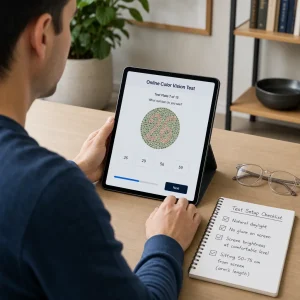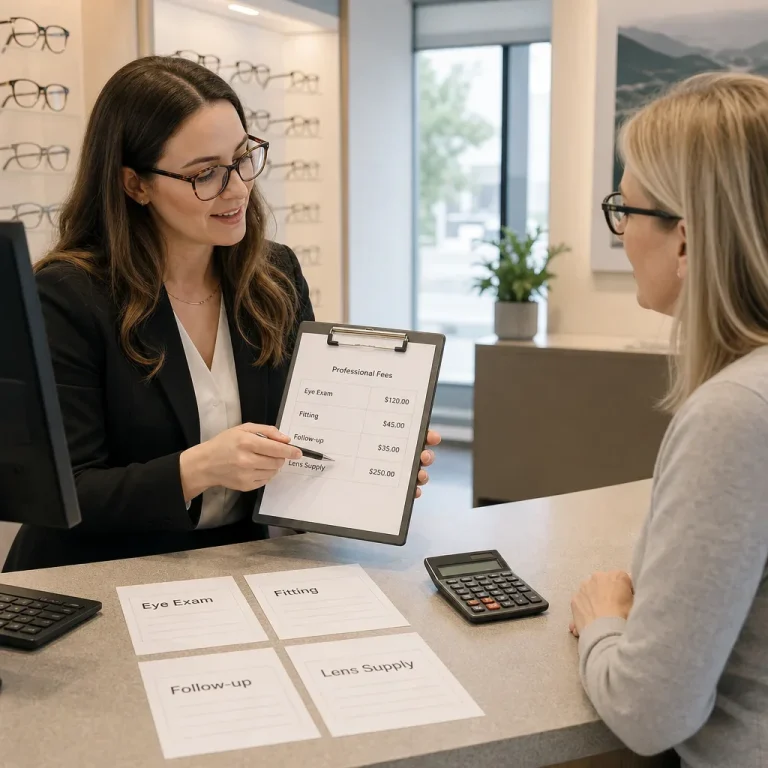
The average contact lens exam cost is rarely one single fee. In Ontario, the total usually combines a comprehensive eye exam, a contact lens fitting, possible follow-ups, and then the lenses themselves, which is why the average cost of contact lens exam searches can feel confusing.
Average contact lens exam cost in Ontario: quick answer
A full contact lens visit in Ontario commonly lands around $150 to $400+ when you combine the eye exam and fitting together . That range is broad for a reason: an established wearer with a simple prescription may need less, while a first-time wearer may need training, trial lenses, and more than one follow-up.
A contact lens fitting on its own is commonly about $50 to $250+ as an add-on to a regular exam . A standard fitting is usually lower. A premium or specialty fit, including scleral lenses or keratoconus-related care, can run materially higher because the measurements, trial process, and follow-up are more involved.
A routine comprehensive eye exam without contact lens fitting is a separate service and often costs less than the combined visit. If you are comparing the average cost of eye exam for contacts, ask whether the quote includes the exam, fitting, teaching, follow-up visits, and trial lenses. That is where most price gaps come from.
What you are actually paying for: exam fee vs fitting fee vs follow-ups
You are usually paying for at least two different services: the eye health exam and the contact lens fitting. The comprehensive exam checks vision and eye health. The fitting decides whether contacts are safe for your eyes and which lens parameters actually fit.
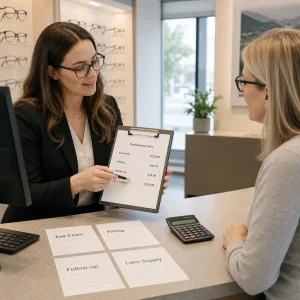
Some clinics bundle services, and some bill each step separately. That is why one low advertised number may not include insertion and removal training, trial lenses, or a recheck after you wear the trial pair for a few days.
| Service | What it covers | Often included? | Often billed separately? | Who usually needs it |
|---|---|---|---|---|
| Comprehensive eye exam | Refraction, prescription check, eye health assessment | Yes | Yes, as base exam | Almost everyone |
| Contact lens fitting | Corneal and tear film assessment, lens selection, fit evaluation | Sometimes | Often | New and returning wearers |
| Trial lenses | Trial pair to test vision and comfort | Sometimes | Sometimes | Usually first-time or changing lenses |
| Insertion/removal training | How to put in and remove lenses safely | Sometimes | Sometimes | First-time wearers |
| Follow-up visit | Recheck comfort, movement, vision, and eye response | Sometimes | Sometimes | Often first-time or complex fits |
| Replacement lenses | Your take-home supply | No | Yes | Everyone who buys contacts |
| Cleaning solution and case | Care supplies for reusable lenses | No | Yes | Monthly and reusable lens wearers |
A standard versus premium contact lens fitting usually comes down to complexity, not marketing language. A basic spherical prescription with healthy tear film is simpler. Astigmatism, multifocal needs, dry eye, irregular corneas, or specialty materials usually add time and steps.
What is included in a contact lens exam and fitting?
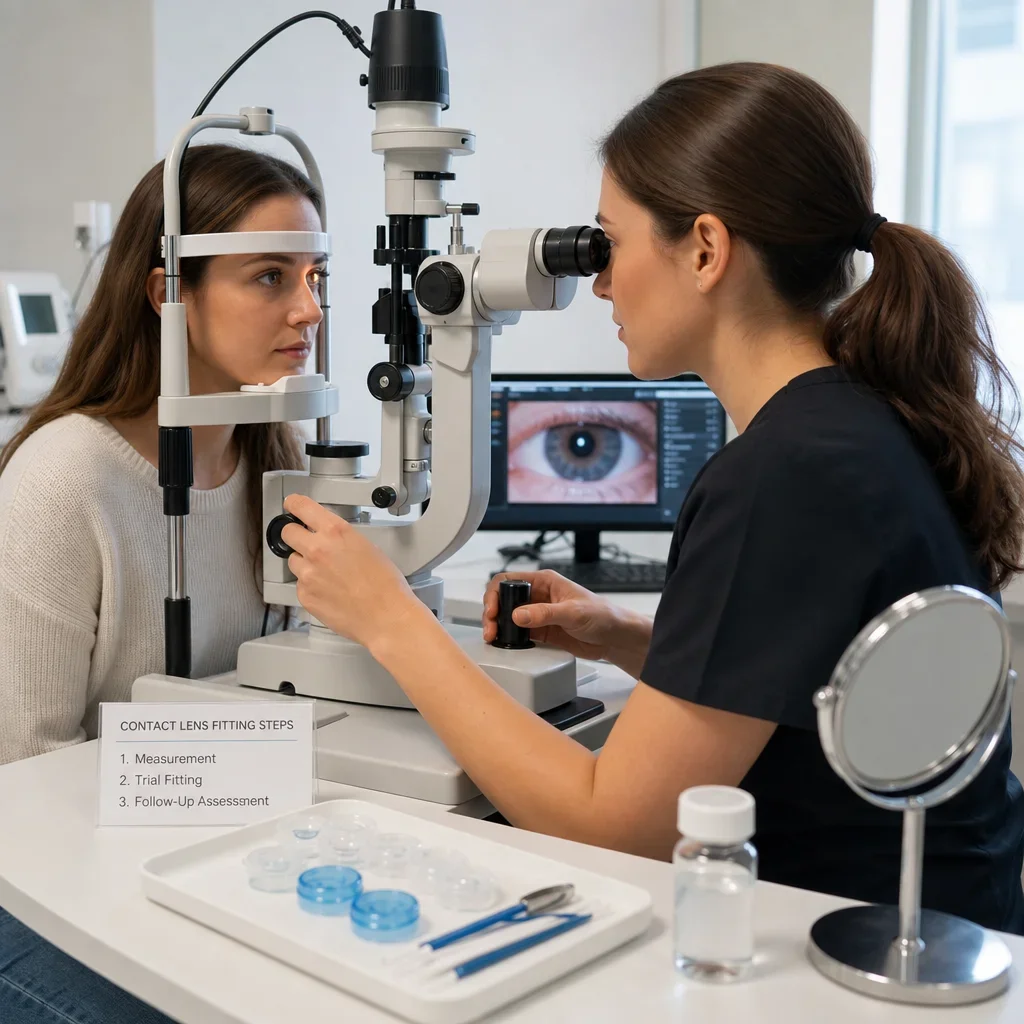
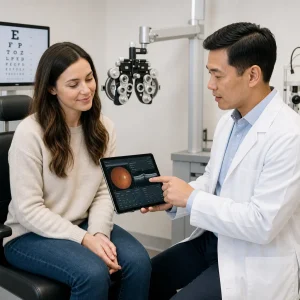
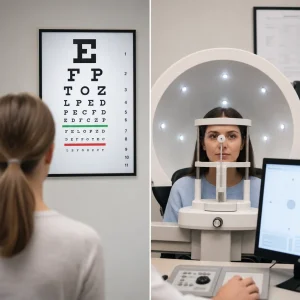
A contact lens exam includes more than reading letters on a chart. The visit commonly includes health history, a vision check, refraction, eye health evaluation, corneal measurements, tear film assessment, lens selection, trial lens assessment, and a fit check after the lenses are on your eyes.
The appointment often takes 20 to 60+ minutes depending on whether you are a new wearer and how complex the fit is . First-time wearers usually take longer because they may need hands-on training and a second visit to confirm comfort and eye response.
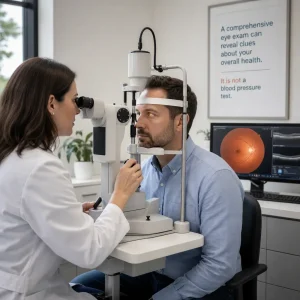
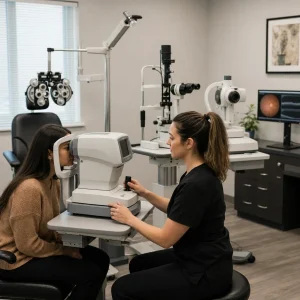
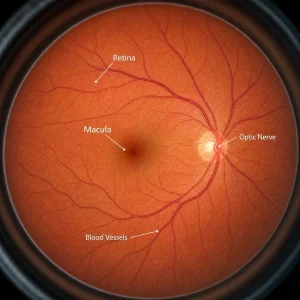
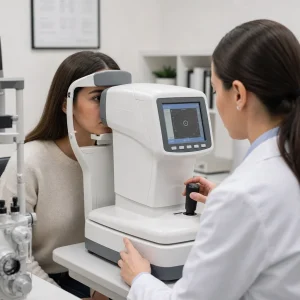
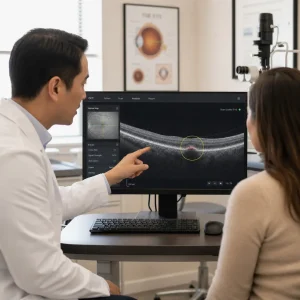
The tools are specific and practical. A slit lamp lets the optometrist examine the front surface of the eye closely. Keratometry measures corneal curvature. Some cases may call for corneal topography, which creates a more detailed map of the cornea. Tear film evaluation matters because dry eyes can make a good lens feel like a bad one.
A fitting also tests how the lens behaves on your eye, not just whether the power is clear. The optometrist looks at movement, centration, comfort, and how the lens interacts with your cornea and tear film. That is why a glasses prescription alone is not enough for contact lenses.
Measurement checklist
- Refraction for lens power
- Corneal curvature measurement
- Tear film and dry eye check
- Slit lamp eye health assessment
- Trial lens fit and movement check
- Comfort and vision check after settling time
- Follow-up review if needed
Comprehensive eye exam vs contact lens exam: what is the difference?
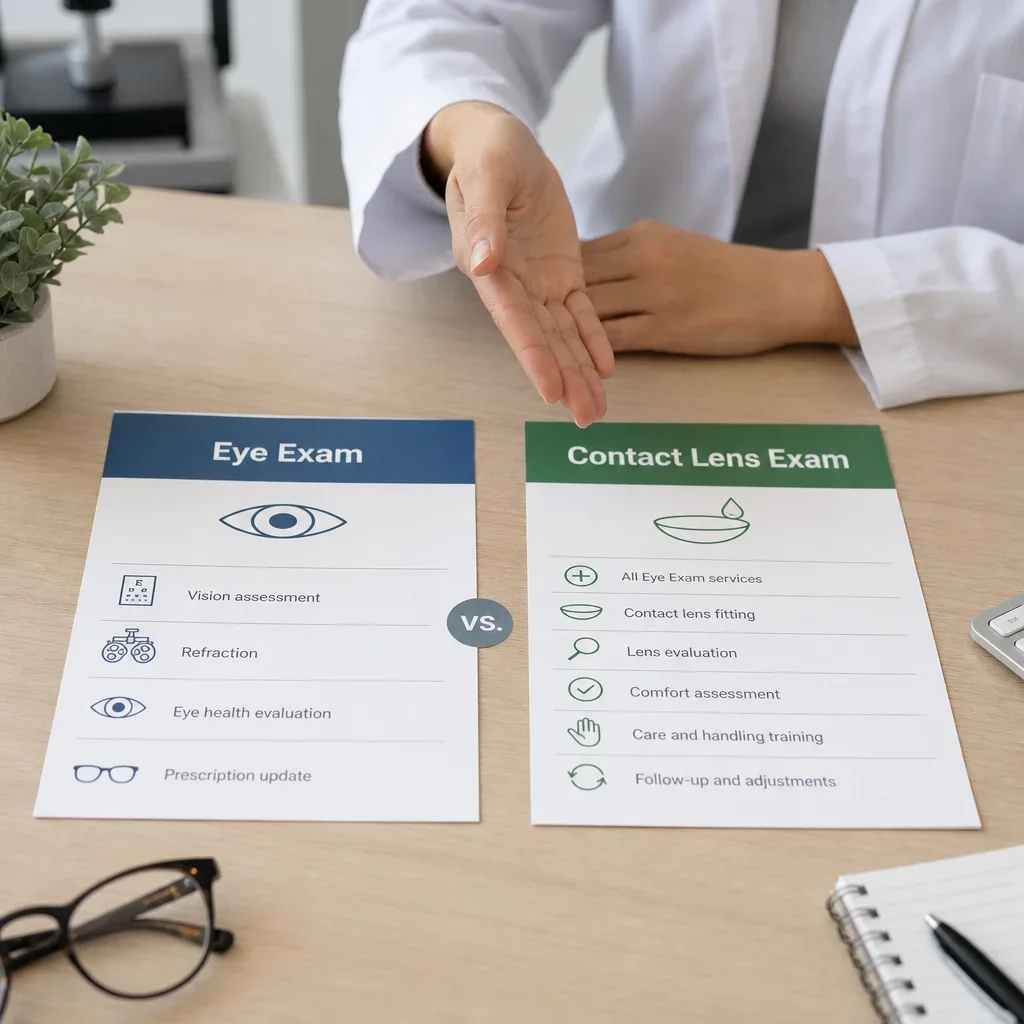
A comprehensive eye exam checks how well you see and whether your eyes are healthy. A contact lens exam adds the fitting work needed to decide if contacts are appropriate, which lens design fits, and what parameters should go on the contact lens prescription.
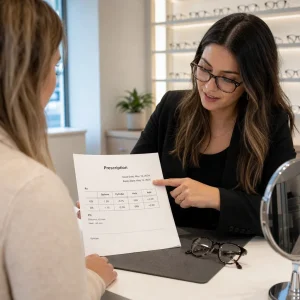
A contact lens prescription contains details a glasses prescription does not. Contact lenses sit directly on the eye, so the prescription may include base curve, diameter, brand or approved lens design, and, where needed, cylinder, axis, or add power.
That extra work is why the average cost of contact eye exam searches often produce mixed numbers. Some people mean a regular eye exam. Others mean the full exam plus fitting. If you want the average cost of eye exam and contacts, treat the exam, the fitting, and the lens supply as separate costs first.
What makes the price go up? Complexity factors that affect contact lens fitting cost
The biggest drivers of contact lens fitting cost are complexity and follow-up time. First-time wearers, astigmatism, presbyopia, dry eye, high prescriptions, post-surgery eyes, keratoconus, and irregular corneas usually require more assessment and more trial-and-adjust cycles.
A low advertised fee may only apply to a basic spherical fit. That is the kind of cheap contact lens fitting offer that can sound comparable when it is not. If your eyes need toric, multifocal, rigid gas permeable, or scleral lenses, the process is different.
A simple way to think about standard vs premium contact lens fitting is this:
- Standard: healthy eyes, straightforward spherical prescription, minimal training
- Moderate complexity: astigmatism, mild dryness, multifocal needs, lens brand change
- Specialty: keratoconus, irregular cornea, significant dry eye, post-surgical cornea, scleral or RGP lens fitting
The price rises because the provider is doing more than dispensing a product. More measurements, more trial lenses, more teaching, and more follow-ups all take chair time and clinical judgment.
Insurance, OHIP, and out-of-pocket costs in Ontario
Private insurance may help with eye exams, contact lens fittings, or the lens purchase itself, but coverage is plan-specific. Some policies pay toward the exam only. Some include a separate vision allowance. Some exclude fittings or limit them to certain intervals.
OHIP and private insurance are not the same thing. OHIP-insured eye exams in Ontario depend on eligibility rules set by the province, and contact lens fittings are commonly treated differently from insured medical or routine eye exams. For current eligibility, check Ontario’s official coverage rules or ask the clinic to review your file before the visit.
If you want to know how much a contact lens exam is without insurance, the practical answer is to budget for the full private-pay visit. In Ontario, that usually means paying the exam fee, the fitting fee, and then any lenses or supplies not included in the clinic package.
Direct billing can reduce the paperwork, but it does not change what your plan actually covers. At Premier Optical in Waterloo, patients can ask about direct insurance billing and one-stop care with licensed optometrists, experienced opticians, and in-house support.
How much should you budget for year one of contact lenses?
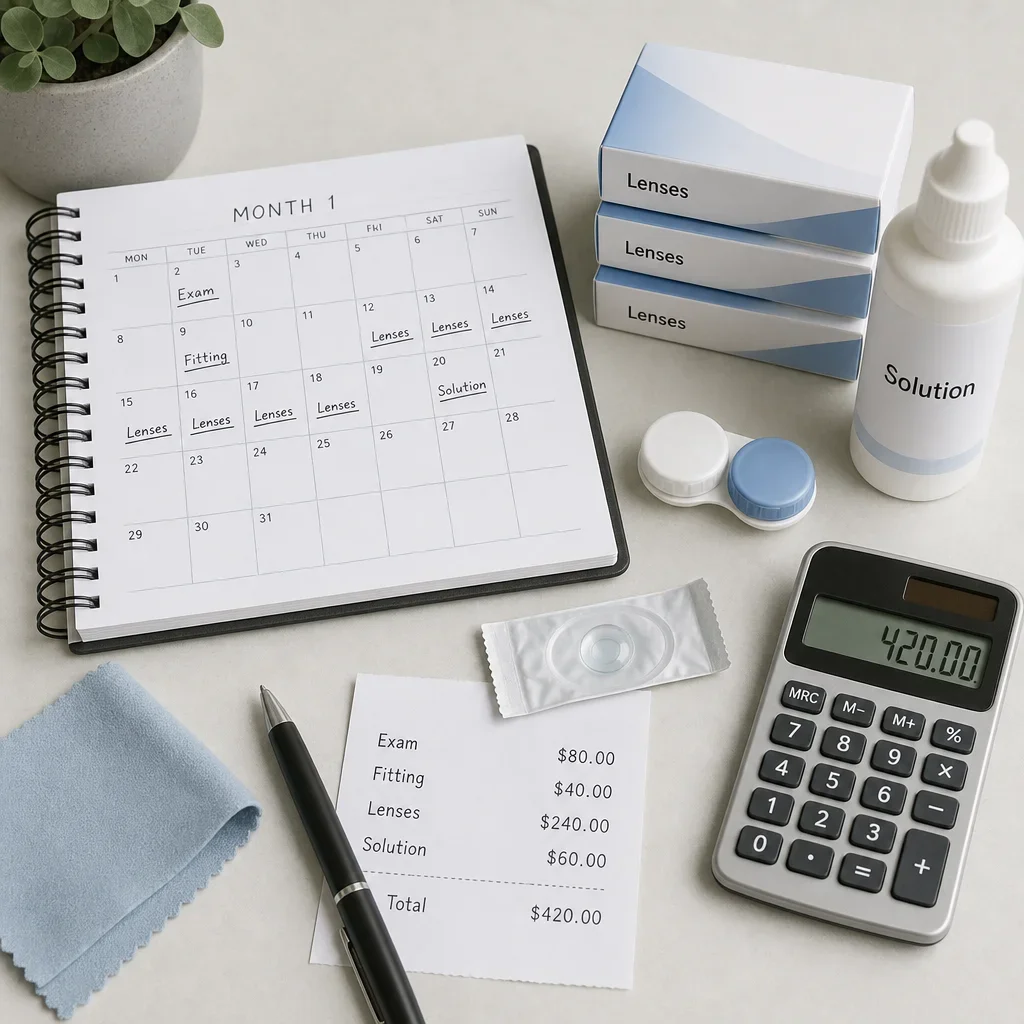
Year one usually costs more than later years because you are paying for setup. The first-year budget may include the comprehensive exam, fitting, follow-up visits, trial lenses, the first lens supply, and care products if the lenses are reusable.
The broadest cost swing is lens type. Daily disposables usually cost more over a full year because you open a fresh pair each day. Monthly lenses may cost less per day but add cleaning solution and stricter care habits.
The cleanest way to budget is by categories, not by one headline number:
| Cost category | First-time wearer | Current wearer renewing |
|---|---|---|
| Comprehensive eye exam | Usually needed | Usually needed |
| Contact lens fitting | Usually needed | Often needed, sometimes simpler |
| Follow-up visits | More likely | Less likely if stable |
| Trial lenses | Common | Sometimes |
| Lens supply | Required | Required |
| Solution and case | Needed for monthly/reusable lenses | Needed for monthly/reusable lenses |
| Backup glasses | Strongly recommended | Usually already owned |
A 30-day supply of contacts does not have one Ontario-wide price because cost depends on the brand, daily versus monthly schedule, toric versus spherical design, and whether the lenses are specialty materials. If you are comparing the best price for eye exam and contacts, ask for a written quote that separates clinical fees from product costs.
Is a cheap contact lens exam worth it?
A cheap contact lens eye exam can be worth it only if the low fee still includes the clinical steps you actually need. A low sticker price that excludes fitting, follow-up, or prescription release can stop being cheap quickly.
The main risk in chasing the cheapest contact lens test is poor comparison. One clinic may include trial lenses and a follow-up. Another may advertise only the base exam. The lower number is not better if it leaves out the step that prevents discomfort or a bad fit.
Compare these points before you book:
- Is the comprehensive eye exam included?
- Is the contact lens fitting included or separate?
- Are follow-up visits included, and for how long?
- Are trial lenses included?
- Is insertion and removal training included for beginners?
- Will you receive a valid contact lens prescription after the fitting is complete?
- Is eye health screening part of the visit?
That is the difference between the best price for contact lens exam and the cheapest headline number. Good value means the exam is complete, the fit is safe, and you are not paying twice for omitted steps.
Do I qualify for contacts? When contacts may not be the best option
Many people who assume they are not candidates can still wear contacts. Astigmatism can often be corrected with toric lenses. Presbyopia can often be managed with multifocal designs. Even some more complex corneas can be fitted with specialty lenses.
What can rule contacts out, at least for now, is usually an eye health or wear-safety issue. Common examples include unmanaged dry eye, poor tear film, active eye infection, recurrent corneal irritation, certain surface diseases, poor lens hygiene habits, or repeated sleeping in lenses against instructions.
Ocular hypertension does not create one universal yes or no answer. Suitability depends on your eye health, treatment plan, lens type, and how your eyes respond on exam. That decision needs an optometrist’s assessment, not an online checklist.
Some disqualifiers are temporary. Dry eye can sometimes be treated first. Hygiene issues can be corrected with better habits and training. A failed fit is not always a permanent no.
Best fitting contact lenses by eye type and lifestyle
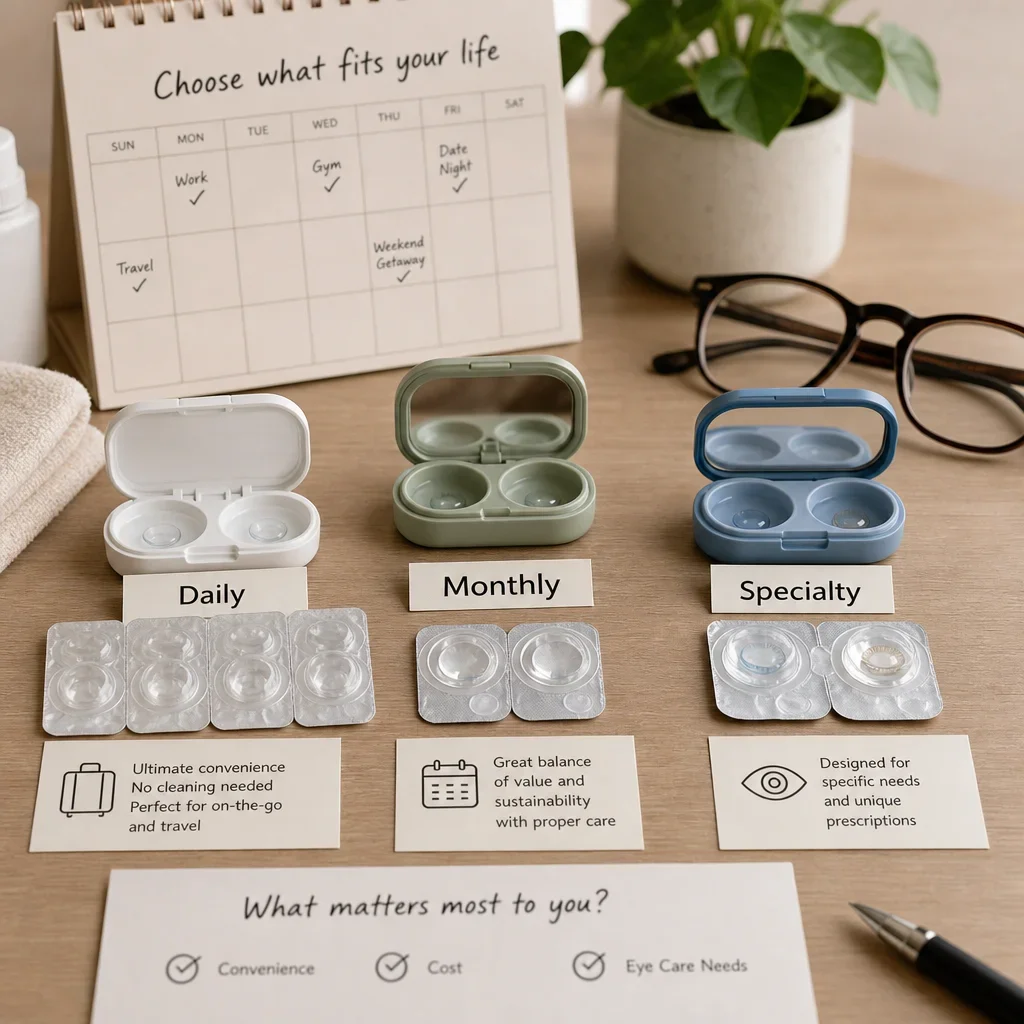
The best fitting contact lenses are the ones that match your corneal shape, prescription, tear film, and wear schedule. There is no single best contact lenses Canada answer that works for every eye.
For beginners, daily disposables are often the simplest option because they skip cleaning and reduce handling errors. For occasional wear, dailies are also convenient because you open a fresh pair only when needed. For regular full-time wear, monthly lenses may be a practical value choice if your eyes tolerate them well and you follow cleaning instructions consistently.
For dry eyes, the material and replacement schedule matter as much as the brand. For astigmatism, toric lenses are often the starting point. For multifocal needs, the fit may take more trial and adaptation because near and distance vision must be balanced on the eye.
Daily vs monthly contacts: a simple decision guide
| Need | Daily disposables | Monthly lenses |
|---|---|---|
| Convenience | Strong | Moderate |
| Cleaning required | No | Yes |
| Good for occasional wear | Strong | Less ideal |
| Ongoing product cost | Usually higher | Often lower per day |
| Dry-eye comfort | Often good | Depends on material and care |
| Handling routine | Simple | More steps |
If you are asking which contact lenses are best daily or monthly, start with lifestyle and eye health first, not price alone. The cheapest replacement schedule is the wrong choice if comfort is poor or care habits slip.
Special cases: astigmatism, keratoconus, dry eye, and multifocal needs
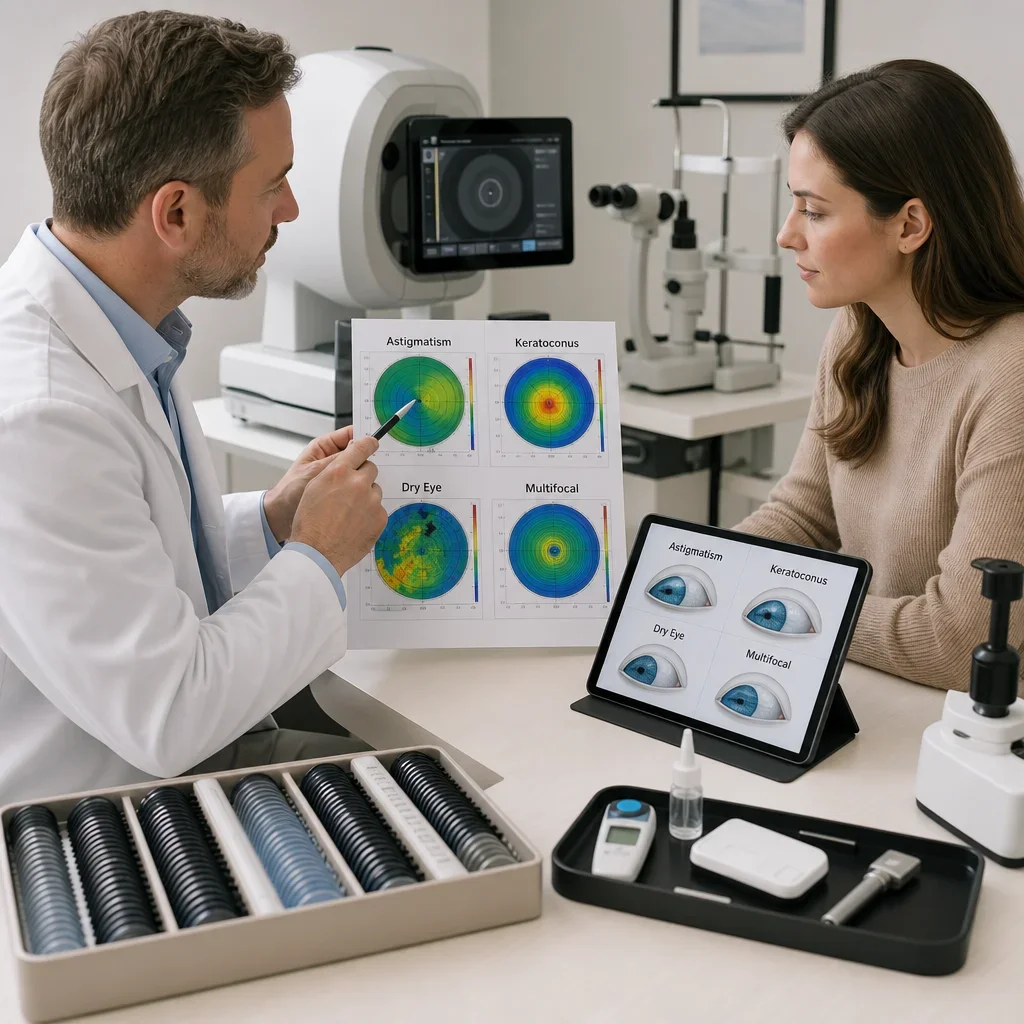
Astigmatism does not automatically rule out contacts. Many wearers do well in toric soft lenses, and some need specialty options if the corneal shape is less regular.
Keratoconus is different because the cornea can become irregular enough that standard soft lenses may not give stable vision. In those cases, specialty lenses such as rigid or scleral designs may be considered, and the fitting process is usually more complex.
Dry eye changes both comfort and lens tolerance. The right approach may involve a different material, a different replacement schedule, shorter wear times, or treating the tear film first before finalizing the contact lens fit.
Multifocal and presbyopia fits can take longer because the lens has to balance distance and near tasks on the eye. That is one reason premium fitting categories exist. More testing and follow-up do not mean something is wrong. They usually mean the fit is being refined properly.
Contact lens prescription explained: BC, DIA, CYL, AXIS and ADD
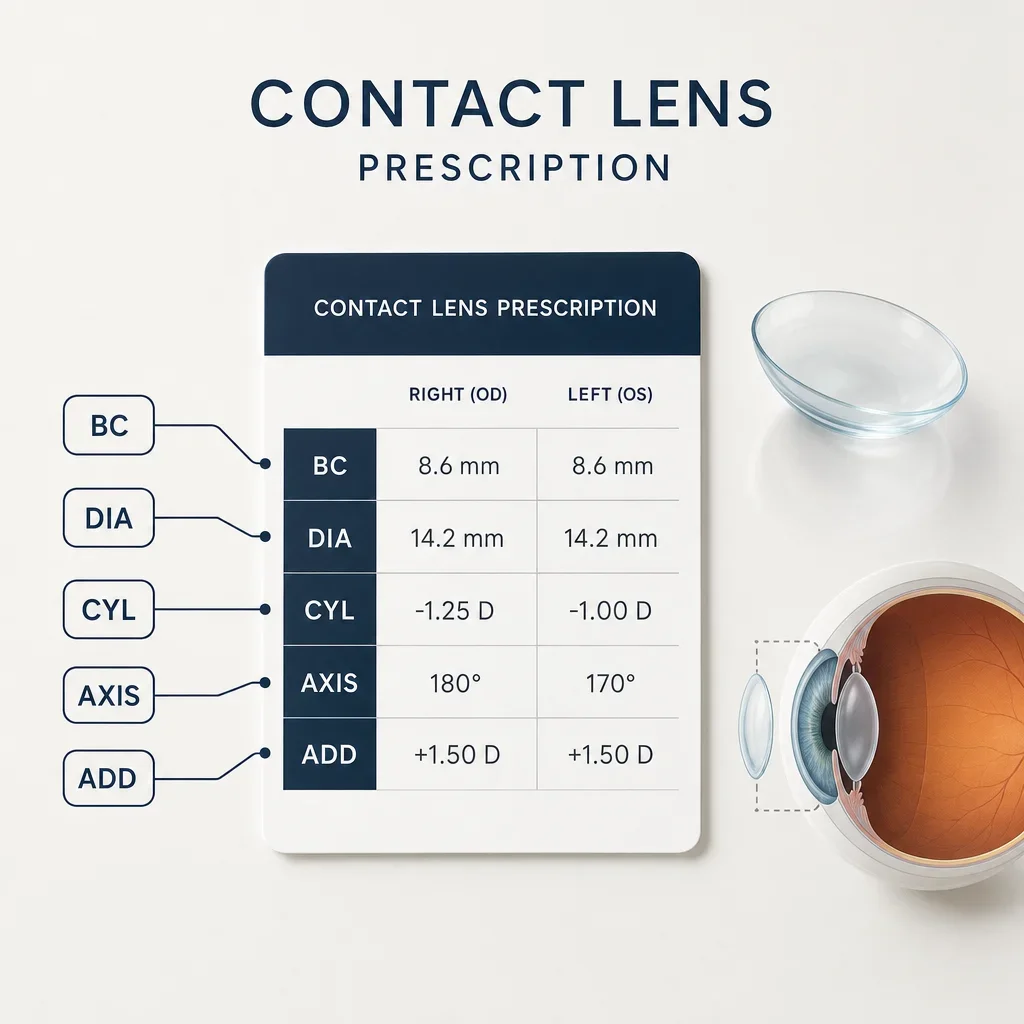
A contact lens prescription is different from a glasses prescription because it includes fit information. The main fields you may see are BC, DIA, CYL, AXIS, and ADD.
BC means base curve. It describes the curve of the back surface of the lens and helps determine how the lens sits on the eye.
DIA means diameter. It is the width of the contact lens and affects coverage, centration, and movement.
CYL means cylinder. It is used when correcting astigmatism.
AXIS is the orientation of astigmatism correction in degrees. It works together with CYL.
ADD is the added near power used in multifocal contact lenses for presbyopia.
This is why you should not order contacts using only a glasses prescription or an expired contact lens prescription. The power may look similar, but the fit, approved lens design, and corneal response still matter.
Safety callout: can you nap or sleep in contact lenses?
Unless a lens is specifically prescribed for overnight wear, sleeping or napping in contacts raises the risk of dryness, irritation, and infection. That applies whether you close your eyes for 5 minutes, 20 minutes, 1 hour, or 3 hours.
A short nap is not risk-free just because it is short. Closing your eyes reduces oxygen flow at the cornea, and that can make a lens less safe and less comfortable. If you think you may doze off regularly, tell the optometrist before choosing a lens type.
Internet shortcuts like the 3-1-1 rule or 4-to-1 rule are not a substitute for the wear schedule your optometrist gives you. Wear time depends on the lens material, your tear film, your eye health, and whether the lens was prescribed for extended wear.
What to do before your exam and how often to come back
Bring your current glasses, your contact lens boxes or prescription details, your health card if relevant, your insurance information, and a list of symptoms or questions. Those details help the clinic compare what you wear now with what may work better.
Some measurements can be affected by recent contact lens wear, so clinics may ask you to leave lenses out for a period before certain exams. The exact timing depends on the lens type and the test being done, so follow the clinic’s instructions rather than guessing.
Many contact lens wearers are reviewed about once a year when things are stable . That is general guidance, not a universal rule. Frequency can change based on age, prescription changes, astigmatism, dry eye, ocular findings, and how often you wear contacts.
If you have astigmatism or a more complex fit, regular follow-up matters because comfort and lens stability can drift even when vision still seems acceptable day to day.
Why book a contact lens exam at a local Waterloo clinic instead of chasing the lowest advertised price?
Local care is valuable when the visit includes more than a quick refraction. A contact lens exam can involve fitting advice, trial support, follow-up, eyewear backup, and help if the first lens choice is clear but uncomfortable.
That all-in-one model is especially useful for first-time wearers and for anyone comparing the average cost of eye exam and contacts against real-world convenience. One visit can cover the eye exam, fitting discussion, prescription eyewear needs, and insurance paperwork instead of sending you to different places.
In Waterloo and Kitchener, many patients want clear pricing, direct billing where available, and support from licensed optometrists and experienced opticians under one roof. That is usually a better value calculation than picking a number that looks cheap online and sorting out missing pieces later.
FAQ
How much does a contact lens exam cost in Ontario?
A combined eye exam and contact lens fitting often falls around $150 to $400+ in Ontario . First-time, multifocal, toric, or specialty fits can cost more.
What is the average cost of a contact lens fitting?
A contact lens fitting add-on is commonly about $50 to $250+ depending on complexity . Specialty fits can be higher.
Is a contact lens fitting included in a regular eye exam?
Usually not automatically. Some clinics bundle it, but many bill the comprehensive eye exam and the fitting as separate services.
How much is a contact lens exam without insurance?
Without insurance, you usually pay the private rate for the eye exam, fitting, any follow-ups not bundled, and then the contact lenses themselves.
Do I need a contact lens fitting if I already wear contacts?
Usually yes, if you need a renewed contact lens prescription or want to change brands, powers, or lens types. A stable returning wearer may need a simpler review than a first-time wearer.
Why does a contact lens exam cost more than a standard eye exam?
Because it includes fit-specific work. The optometrist checks corneal shape, tear film, lens movement, comfort, and sometimes trial-and-follow-up results before finalizing the prescription.
What is included in a contact lens exam?
Common steps include vision testing, refraction, eye health assessment, corneal measurements, tear film evaluation, lens selection, trial fitting, and follow-up if needed.
Can I wear contacts if I have astigmatism?
Often yes. Many people with astigmatism do well in toric lenses, though some need specialty options depending on the shape of the cornea.
What contact lenses are best for keratoconus?
There is no one universal best lens. Some people with keratoconus need specialty lenses such as rigid or scleral designs, and the right option depends on corneal shape and eye health.
Can I nap in contact lenses?
Unless the lenses were specifically prescribed for overnight wear, napping in them is not considered safe. Even short naps can increase dryness, irritation, and infection risk.
Can I order contacts with an expired prescription?
You should not rely on an expired prescription for reordering. Contact lens prescriptions need current fit and eye-health confirmation, not just the old power.
Does insurance cover contact lens fittings in Ontario?
Sometimes, but not always. Private vision plans vary widely, and OHIP rules are separate. Check your benefit booklet or ask the clinic to review your coverage before the visit.
The practical next step is simple: ask for a written quote that separates the exam, fitting, follow-ups, and lenses. That is the fastest way to compare value, not just the sticker price, before you book a contact lens exam in Waterloo.