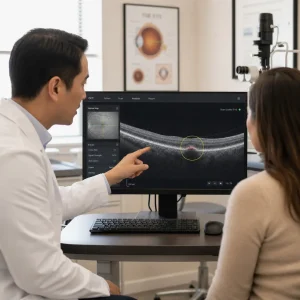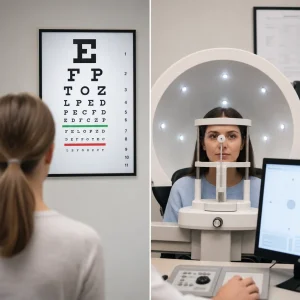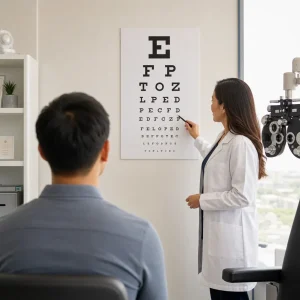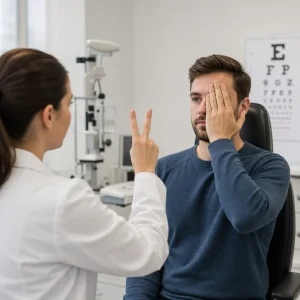
A common myth is that the machine alone gives your final glasses prescription. An auto refraction eye exam is really a fast starting measurement inside a broader eye exam, not the whole story.
What an Auto Refraction Eye Exam Is
An auto refraction eye test is an automated measurement that estimates how your eyes focus light and helps determine refractive state, which means whether you are nearsighted, farsighted, have astigmatism, or need near-vision help. It is one part of an eye refraction examination, and by itself it measures prescription-related blur rather than overall eye health.
An autorefraction eye test does not do the same job as a visual acuity chart, dilation, retinal imaging, or a comprehensive eye exam. A chart tells how well you see at that moment, while computerized eye refraction estimates the lens power that may sharpen that vision.
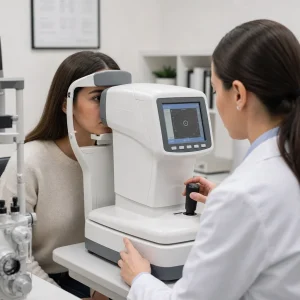
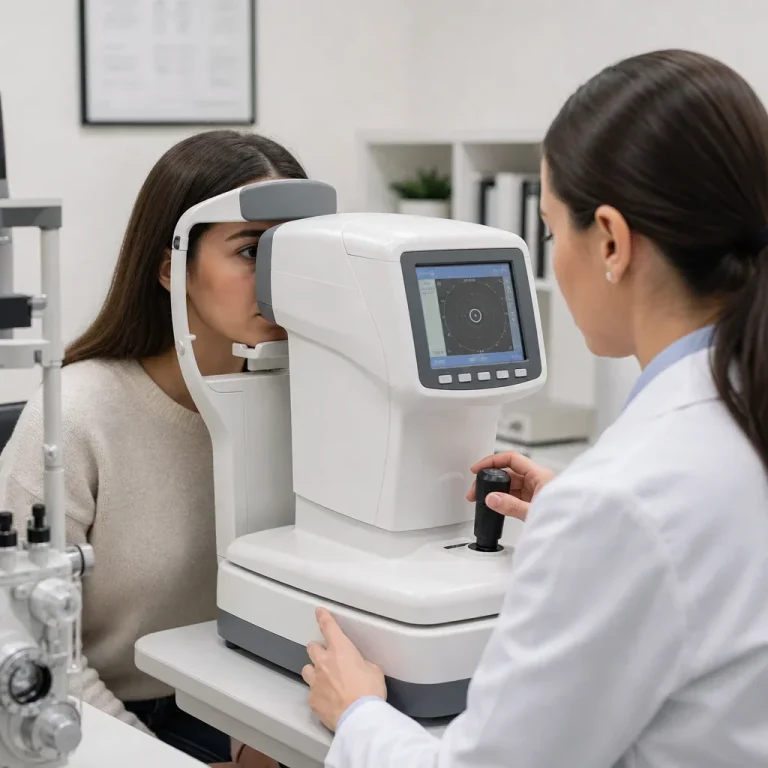
An autorefractor test is usually quick and non-invasive. You rest your chin, look at a target, and the machine measures how light reflects through each eye in seconds per eye. The printout gives a starting point that the optometrist still needs to confirm and refine.
Auto Refraction vs a Regular Eye Exam: What’s the Difference?
A refraction is the prescription part of testing, while a regular comprehensive eye exam also checks eye health, visual function, and any signs that need clinical follow-up. That is the simplest eye exam refraction explanation.
Refraction may still be useful even if you can read some chart lines, because seeing letters is not the same as finding the most comfortable, balanced prescription for real-world vision. The final prescription can change after comparing lenses, checking clarity at distance and near, and balancing both eyes together.
An autorefractor is commonly useful because it gives a fast objective estimate before the more subjective part of the exam. It is not always mandatory in every visit, and it does not replace clinical judgment or the rest of the assessment.
| Test | What it measures | What it is good for | What it cannot do alone |
|---|---|---|---|
| Autorefraction | Estimated refractive error from a machine | Fast starting point for prescription testing | Cannot replace full eye-health assessment |
| Subjective refraction | Your best vision through lens choices | Fine-tunes comfort and clarity | Depends on patient responses |
| Comprehensive eye exam | Vision plus eye health and function | Evaluates the bigger picture | Is not limited to prescription alone |
How the Test Works and What Happens Step by Step
The test works by sending light into the eye and measuring how it focuses back through the optical system. That is why an auto refractometer test is considered an objective measurement before the manual refraction test begins.
The first step is usually the machine reading. You place your chin on the support, look at a picture or light, keep both eyes open unless told otherwise, and the device captures several readings.
The next step is chart testing. You read letters at distance, and sometimes near, so the optometrist can compare the machine estimate with your actual visual acuity.
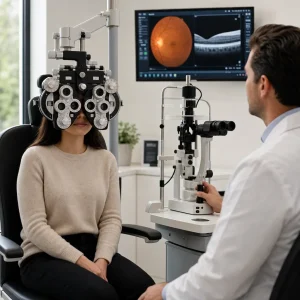
The next step is subjective refinement through a phoropter or trial lenses. This is the part where you hear, “Which is better, one or two?” because the clinician is narrowing the lens power that gives the clearest and most comfortable result.
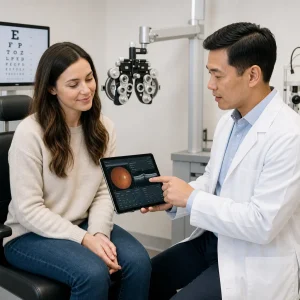
The final step is clinical interpretation. A full eye exam visit commonly takes about 30 to 60 minutes depending on testing, discussion, and whether extra health checks are needed. The refraction portion itself is usually much shorter than the whole visit.
Do You Need Eye Drops, Dilation, or Any Special Preparation?
Standard autorefraction usually does not require eye drops. Most patients can do the test as they are, with no fasting, no recovery time, and no special prep beyond bringing their current glasses or contact lens information.
Refraction is not the same as dilation. Dilation uses drops to widen the pupil for a better view inside the eye, while autorefraction measures focusing error; the two may happen in the same appointment, but they serve different purposes.
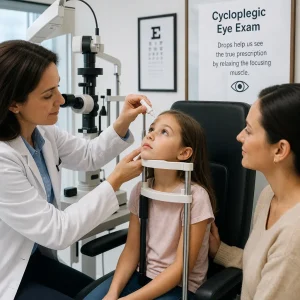
Some patients, especially certain children or people who accommodate strongly, may need cycloplegic drops so focusing muscles do not distort the reading. That decision depends on the clinician and the reason for the visit, not on a rule that applies to everyone.
Contact lens wearers should bring their current lens details because a glasses refraction and a contact lens fitting are not the same service. Contact lens testing may need extra measurements of the cornea and tear film beyond the auto refraction test.
How Accurate Is Autorefraction?
Autorefraction is usually a useful starting measurement, not a guaranteed final prescription. The machine is good at estimating refractive error quickly, but the final answer still depends on comfort, clarity, binocular balance, and clinical review.
An autorefractor can be wrong when the eye surface is dry, the patient blinks too much, fixation is poor, the lens inside the eye is cloudy, or the eyes accommodate during testing. Movement during the reading can also reduce reliability.
Manual refinement still matters because the best-looking number on a printout is not always the prescription a person wears most comfortably all day. That is the main reason autorefraction is not automatically better than subjective refraction.
Inconsistent machine readings should be checked, not ignored. A clinician may repeat the auto refractor test, use retinoscopy, compare old prescriptions, assess dry eye, or rely more heavily on subjective responses if the printout and symptoms do not match.
Autorefraction vs Manual Refraction vs Retinoscopy vs Keratometry
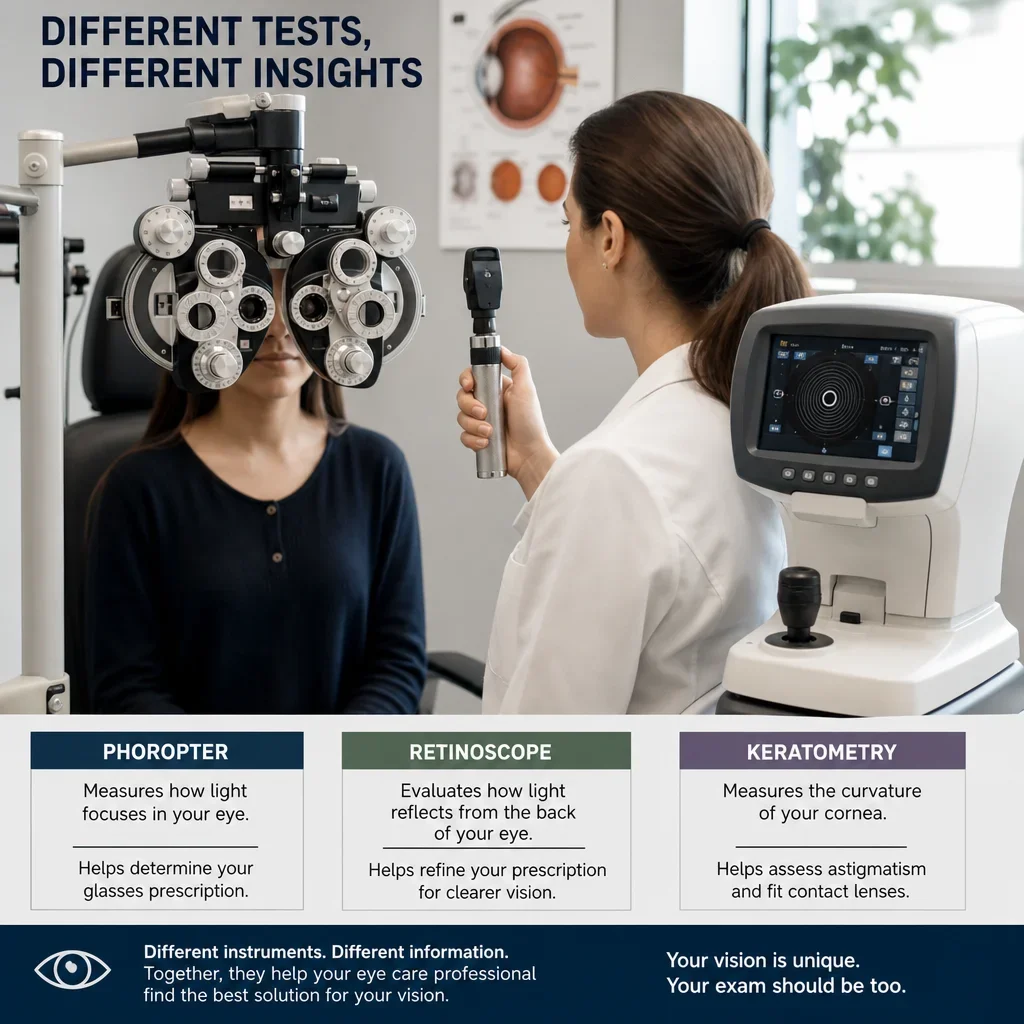
These tests overlap, but they do different jobs. The easiest way to think about them is objective estimate, patient-based refinement, clinician-observed confirmation, and corneal shape measurement.
| Method | What it measures | When it helps | Strengths | Limits |
|---|---|---|---|---|
| Autorefraction | Machine estimate of refractive error | Routine starting point | Fast and objective | Not always the final prescription |
| Manual or subjective refraction | Best lens choice based on your responses | Final glasses refinement | Tailors comfort and clarity | Depends on consistent answers |
| Retinoscopy | Clinician observes light reflex in the eye | Children, limited responses, cross-checking | Useful without detailed patient feedback | Still needs interpretation |
| Keratometry | Corneal curvature | Contact lens workups, corneal assessment | Helps measure front-of-eye shape | Not a full prescription |
| Comprehensive eye exam | Vision and eye health | Full clinical assessment | Evaluates the whole picture | Not limited to refractive error |
Keratometry and corneal measurements matter for contact lenses, but they do not replace a full contact lens prescription. A contact lens fit also depends on lens movement, corneal fit, tear film, and wearing goals.
How to Read Autorefractor Results
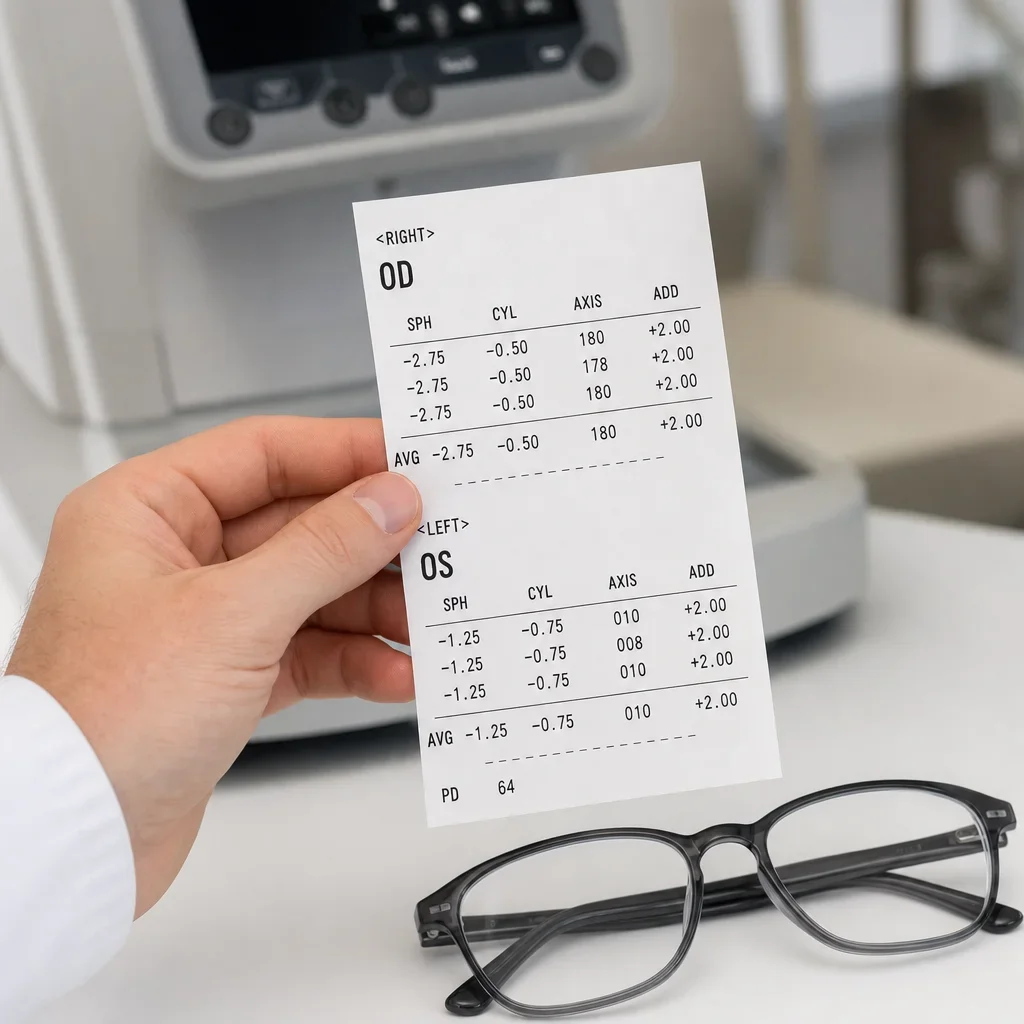
An autorefractor printout usually shows one line for each eye and several abbreviations that describe the estimated prescription. The most common labels are OD for right eye, OS for left eye, SPH or S for sphere, CYL or C for cylinder, AXIS or A for the astigmatism angle, and ADD for extra near power if needed.
Sphere shows the main lens power. A minus sign usually points to myopia, which is nearsightedness, and a plus sign usually points to hyperopia, which is farsightedness.
Cylinder and axis describe astigmatism. Cylinder is the amount of astigmatism correction, while axis is the orientation in degrees from 1 to 180.
ADD refers to extra near magnifying power used in some multifocal prescriptions. PD means pupillary distance if it appears, which is the distance between the centres of your pupils for eyewear alignment.
A sample printout might look like this:
- OD: -2.00 / -0.75 x 180
- OS: -1.50 / -0.50 x 170
- ADD: +1.50
That sample means the right eye has more nearsightedness than the left, both eyes have some astigmatism, and the patient may need extra near help if ADD is clinically confirmed. It is only an example, and machine results are not always the final eyewear prescription.
A so-called normal result is not limited to 0.00. Emmetropia, or no refractive error, is written as 0.00 , but a normal clinical outcome still depends on symptoms, visual needs, and whether the final lenses feel clear and comfortable.
What a Refraction Test Can Detect, and What It Cannot
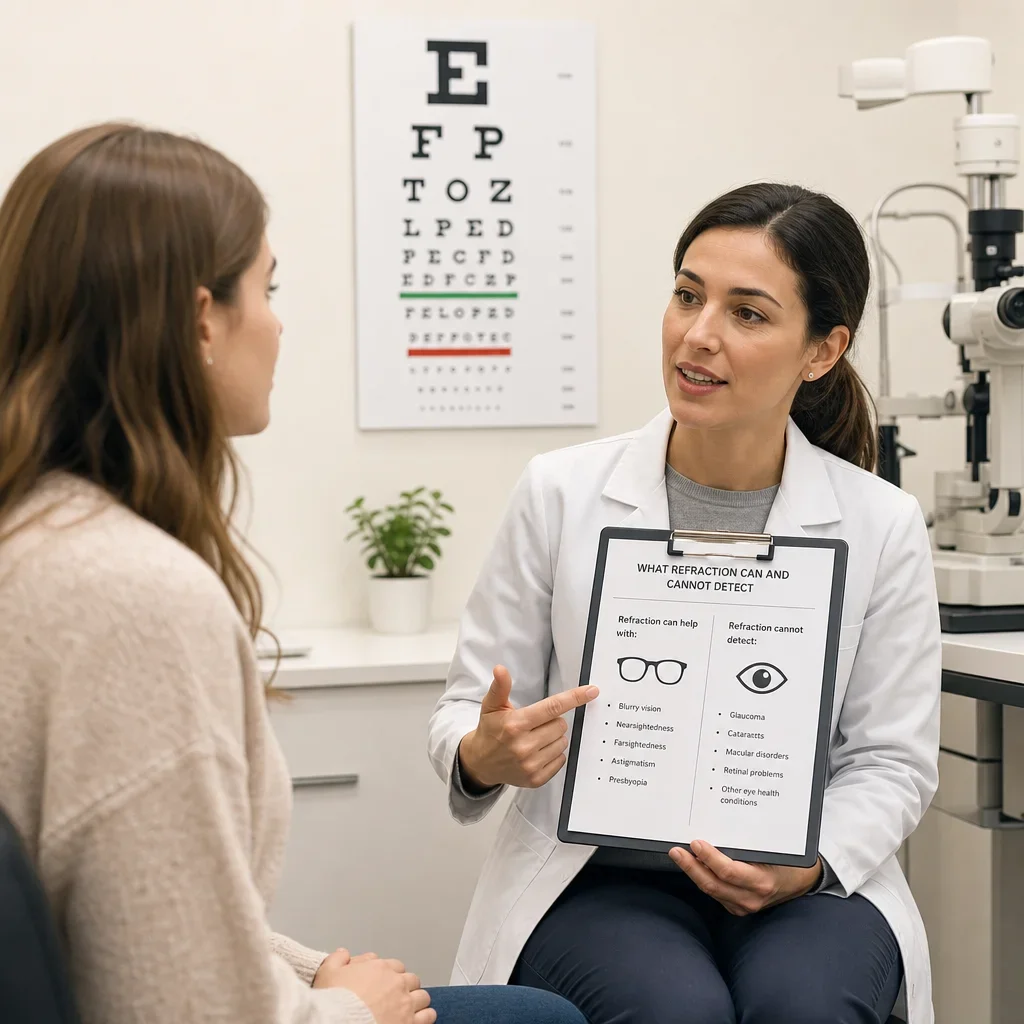
A refraction test can detect refractive errors such as myopia, hyperopia, astigmatism, and presbyopia. It can also show that your prescription has changed since your last exam.
An autorefractor can measure regular astigmatism and may flag unusual or inconsistent readings that suggest the need for closer assessment. It does not diagnose the cause of irregular astigmatism by itself.
Refraction does not diagnose glaucoma, optic nerve disease, multiple sclerosis, aneurysm, cholesterol problems, or cancer by itself. Those concerns belong to a comprehensive eye exam and, when needed, medical assessment and additional testing.
Sudden blur, double vision, flashes, new floaters, or a rapid prescription shift should not be treated like a simple eyewear update. Those symptoms need prompt professional assessment because refractive blur and eye disease are not the same thing.
Common Refractive Errors and Their Symptoms
Myopia means distance vision is blurry because light focuses in front of the retina. People often notice trouble with road signs, classroom boards, or TV subtitles.
Hyperopia means the eye needs extra focusing effort, especially at near, because light tends to focus behind the retina. It can cause near blur, eye strain, or headaches even when distance vision seems decent.
Astigmatism means the eye does not focus evenly in all directions, usually because of corneal or lens shape. It can cause blur, ghosting, glare, and more difficulty with night driving.
Presbyopia is the age-related loss of near focusing ability that often begins around age 40. It usually shows up as trouble reading small print, holding your phone farther away, or needing more light to work up close.
Most refractive errors are common and correctable with glasses, contact lenses, or sometimes surgical assessment. A sudden change is more concerning than the existence of a prescription itself.
What Is a Normal Result? 20/20, Plus/Minus Numbers, and Astigmatism
20/20 refers to visual acuity, not refraction. It describes how well you see a chart at a set distance, while refraction describes the lens power used to sharpen that vision.
Plus and minus numbers are not grades of eye health. A prescription like -4.75 or +3.75 tells lens power in dioptres, not whether someone is healthy, safe to drive, or legally blind.
Astigmatism values also need context. The visual impact depends on the amount, the axis, how well you adapt, and whether other prescription values are present.
A good eye test result is one that matches what you can see comfortably in daily life and what the clinician finds on exam. A bad result is not a single number; it is a result that leaves symptoms unexplained, vision reduced, or eye-health concerns unresolved.
How Often Should You Have Refraction or a Full Eye Exam?
Exam frequency depends on age, symptoms, eye-health risk, and whether you wear contact lenses. Healthy adults are often advised to have routine eye exams every 1 to 2 years depending on age and risk.
Children, seniors, people with diabetes or other health concerns, and contact lens wearers may need different schedules. Insured eligibility and recommended exam timing are also not the same thing, so coverage rules should not be mistaken for clinical advice.
Blur, headaches, trouble with reading, eyestrain on screens, or difficulty driving at night are reasons to book sooner rather than waiting for a routine interval. Sudden visual change should always be assessed earlier.
For Ontario-specific coverage rules, confirm current OHIP or private-plan details before the visit because those policies can change. We would not treat a generic internet answer as a billing rule for your appointment.
Why Refraction May Be Billed Separately
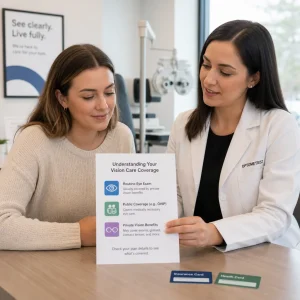
A refraction fee may appear separately because refraction measures prescription, while other parts of an exam may be billed differently depending on the payer and the reason for the visit. That is why some patients see refraction eye exam not covered insurance language even when other parts of care are covered.
Coverage varies by OHIP status, private vision plan, employer benefits, and the exact service performed. The only safe answer is to confirm your own plan before the visit rather than assuming a refraction is always included.
The practical point is simple: coverage can vary even when the rest of the exam is covered. If billing matters to you, ask what is included in the visit type you are booking and whether direct insurance billing is available.
Auto Refraction for Glasses, Contact Lenses, and Surgical Planning
Autorefraction is commonly used as a starting point for glasses prescriptions. It helps the clinician begin lens testing from a measured estimate rather than from scratch.
Contact lens prescriptions need more than autorefraction. A proper contact lens assessment may include keratometry, fit evaluation, tear film review, and lens-specific trial decisions, because the cornea and the lens surface have to work together.
Refractive measurements can also be part of discussions about LASIK or other vision correction procedures. They do not determine candidacy alone, because surgical planning also depends on corneal health, stability, thickness, dry eye status, and broader clinical findings.
Can Online Vision Tests Replace an In-Office Refraction?
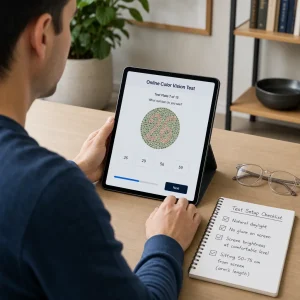
Online tools can suggest that your vision may have changed, but they do not replace an in-office eye exam and refraction. They cannot provide the same clinical refinement, device consistency, or eye-health assessment.
Home or online checks are especially weak for children, first prescriptions, contact lens wearers, and people with complex or changing prescriptions. New symptoms always belong in a clinic, not in a browser-based shortcut.
When to Book an Eye Exam in Waterloo
If your glasses feel off, distance signs look soft, reading is harder, headaches are creeping in, or night driving has become more stressful, it is time to book a proper eye exam Waterloo patients can use to get both answers and an updated prescription.
A local optometrist Waterloo patients trust should be able to do more than print a number from an autorefractor. The real value is getting a comprehensive exam, clear refraction results, frame guidance if you need eyewear, and a practical next step based on what your eyes actually need.
At Premier Optical, patients can book a comprehensive eye exam, review eyewear options, and handle the move from exam to glasses in one place. That all-in-one setup is useful when you want the prescription explained clearly instead of being handed a machine printout and left to guess.
FAQ
What is an auto refraction eye exam?
It is an automated test that estimates your refractive error and gives the optometrist a starting point for your prescription.
What does refraction mean during an eye exam?
Refraction means measuring the lens power needed to focus light more clearly on the retina.
What is the difference between a refraction eye exam and a regular eye exam?
Refraction checks prescription, while a regular comprehensive eye exam also checks eye health and broader visual function.
How long does a refraction test take?
The machine reading usually takes seconds per eye , while the full eye exam visit commonly runs about 30 to 60 minutes.
Does autorefraction require eye drops?
Usually no. Drops may be used only in selected cases, such as some pediatric or accommodation-related assessments.
Do they dilate your eyes for a refraction test?
Not routinely for standard autorefraction. Dilation is a separate part of care used when the clinician needs a better internal view of the eye.
How accurate is auto refraction?
It is often accurate enough to provide a useful starting estimate, but the final prescription still needs clinical refinement.
Can an autorefractor be wrong?
Yes. Dry eye, poor fixation, blinking, cataract, irregular astigmatism, and movement can all affect the reading.
How do you read autorefractor results?
Look first for OD and OS, then SPH, CYL, AXIS, and ADD if present. Those fields describe main lens power, astigmatism amount, astigmatism angle, and near addition.
What do S, C, and A mean on an autorefractor printout?
S means sphere, C means cylinder, and A means axis.
What eye problems can a refraction test detect?
It detects refractive errors like myopia, hyperopia, astigmatism, and presbyopia. It does not diagnose eye disease by itself.
Can an autorefractor detect irregular astigmatism?
It may suggest that readings are unusual or inconsistent, but it does not diagnose the cause of irregular astigmatism on its own.
Is refraction necessary during an eye exam?
If the goal includes updating glasses or checking whether your prescription changed, yes, it is usually a key part of the visit. The exact tests still depend on the clinician and the reason for the exam.
Why is there a separate refraction fee on my bill?
Because the prescription measurement may be billed differently from other exam components depending on coverage.
Is refraction included in a routine eye exam?
Sometimes, but not always. Confirm the visit type and your coverage before the appointment.
How often should eye refraction be done?
That depends on age, symptoms, risk, and whether you wear contact lenses, but many healthy adults are checked every 1 to 2 years.
Can online eye tests replace an in-office refraction?
No. They can screen for change, but they cannot replace in-person refraction and a comprehensive eye-health assessment.
If you are choosing between waiting it out and booking, book the exam when the blur is starting to affect work, reading, screens, or driving. Clarity is easier to fix when you measure it properly.