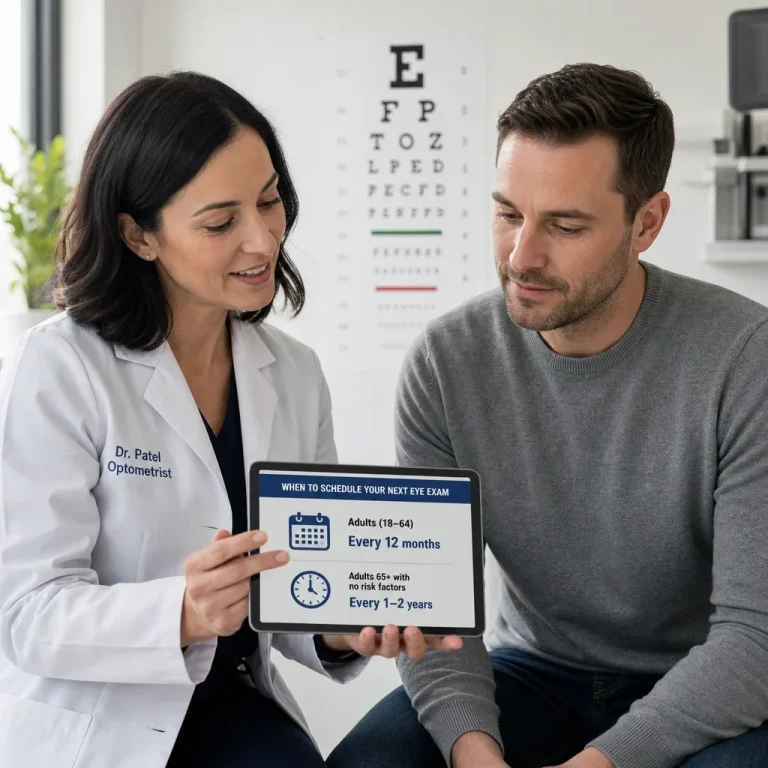
Most people think an annual eye check up is just a quick prescription update. It is not. An annual eye check up usually means a comprehensive eye exam that checks both how you see and how healthy your eyes are.
What Is an Annual Eye Check Up and Do You Really Need One Every Year?
Some people should book every year, while lower-risk adults may be told every 1 to 2 years. The right interval depends on age, symptoms, contact lens wear, medical history, family history, and what the optometrist found at your last visit.
An annual eye examination is more than an annual vision exam for glasses. It includes vision testing, a refraction, which is the part that determines your prescription, and an eye health assessment to look for changes that can happen before vision feels different.
Seeing 20/20 does not rule out early eye disease. Glaucoma, retinal problems, and some diabetic eye changes can develop with few symptoms early on, which is why a routine eye exam is still useful even when vision seems fine.
The practical rule is simple. If you have no symptoms and no known risk factors, your recall may be every 1 to 2 years. If you are a child, a senior, a contact lens wearer, or someone with diabetes or eye disease, yearly eye exam recommendations are often shorter and sometimes more frequent than once a year.
Quick Decision Guide: Annually, Every 2 Years, or Sooner
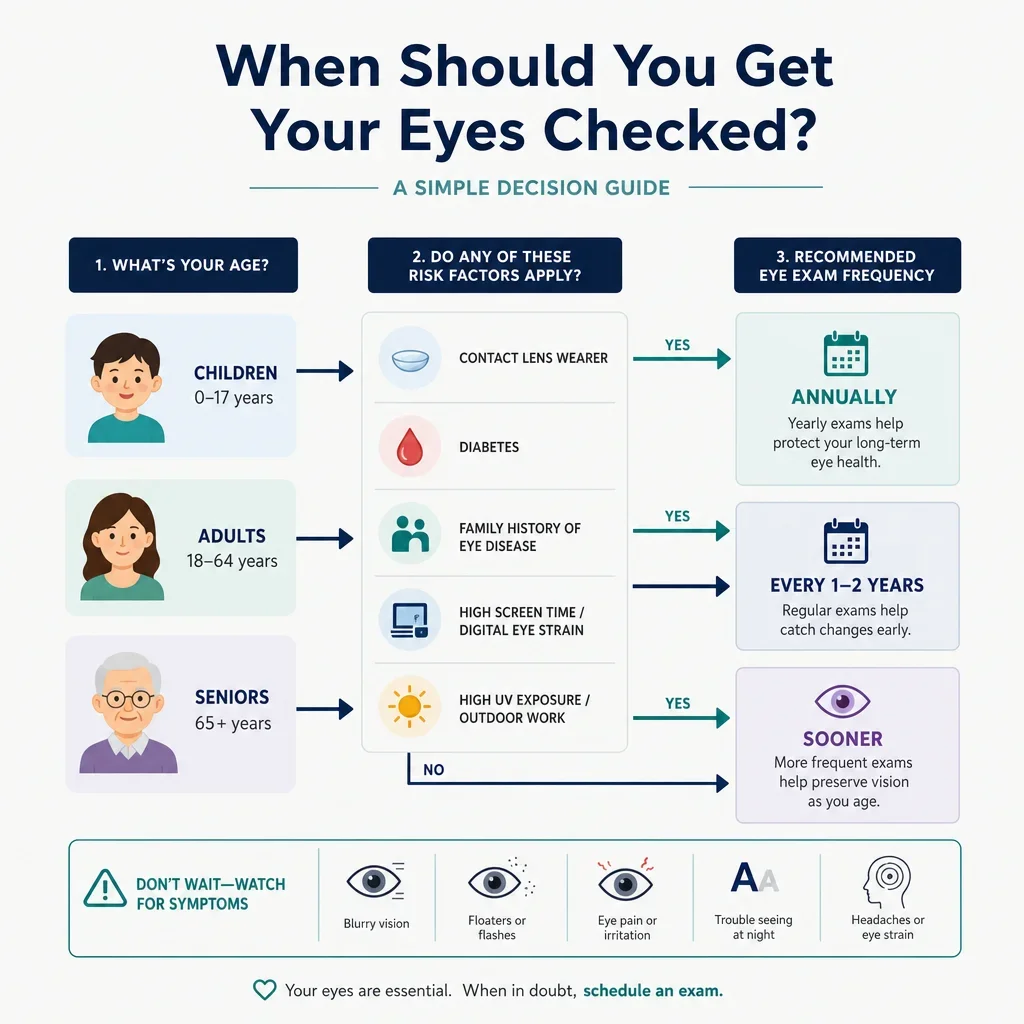
The fastest way to sort this out is by age, risk, and symptoms. If any risk factor applies, your eye exam annual schedule may shorten.
| Group | Typical interval | Why | Book sooner if |
|---|---|---|---|
| Infants | around 6 to 12 months for a first exam | checks early eye development and alignment | eye turn, poor tracking, family concern |
| Children 2 to 5 | at least one exam in this period, sometimes more if advised | catches focusing, eye teaming, and amblyopia risk | squinting, head turn, rubbing, delayed visual behaviour |
| School-age children | about every year | vision can change quickly during school years | headaches, trouble reading, holding devices very close |
| Adults 20 to 64, lower risk | every 1 to 2 years | monitors prescription and eye health over time | blur, headaches, flashes, floaters, one-eye changes |
| Adults 65+ | about yearly, or more often if advised | age raises risk for cataracts, glaucoma, and retinal disease | any sudden change, glare, distortion, falls risk |
| Contact lens wearers | often yearly | lenses affect corneal health and fit must be checked | dryness, redness, discomfort, blurry lens wear |
| Diabetes | at least yearly, sometimes more often if advised | diabetic eye disease can develop without early symptoms | fluctuating vision, new floaters, missed follow-up |
| Family history of glaucoma | often yearly or as advised | risk may be higher even before symptoms | pressure changes, side vision concerns |
| High prescription | often closer follow-up if advised | higher prescriptions can carry added retinal or fit concerns | flashes, floaters, distorted vision |
| Known eye disease or post-surgery care | as directed by the optometrist or surgeon | monitoring intervals are condition-specific | any new symptom or medication change |
| Anyone with new symptoms | sooner than routine | timing matters more than the calendar | sudden pain, sudden blur, flashes, curtain-like shadow |
This is a guide, not a diagnosis tool. The optometrist decides exam frequency based on your health, findings, and prescription history.
Why Routine Eye Exams Matter Even If You Can See Fine
Routine exams matter because clear vision is only one part of eye health. A comprehensive eye exam can also look for signs of glaucoma, cataracts, macular changes, retinal tears, diabetic retinopathy, dry eye, and binocular vision problems, which means how well the eyes work together.
An eye exam may also show signs that point to broader health issues. Changes in the retina or blood vessels can sometimes raise concern about diabetes, high blood pressure, or high cholesterol, but an eye exam does not replace medical testing and does not confirm those conditions on its own.
A yearly eye check up also builds a baseline. That matters because subtle changes are easier to spot when we can compare this year’s refraction, eye pressure, retinal appearance, and symptoms with previous visits.
What Happens During a Yearly Eye Exam?
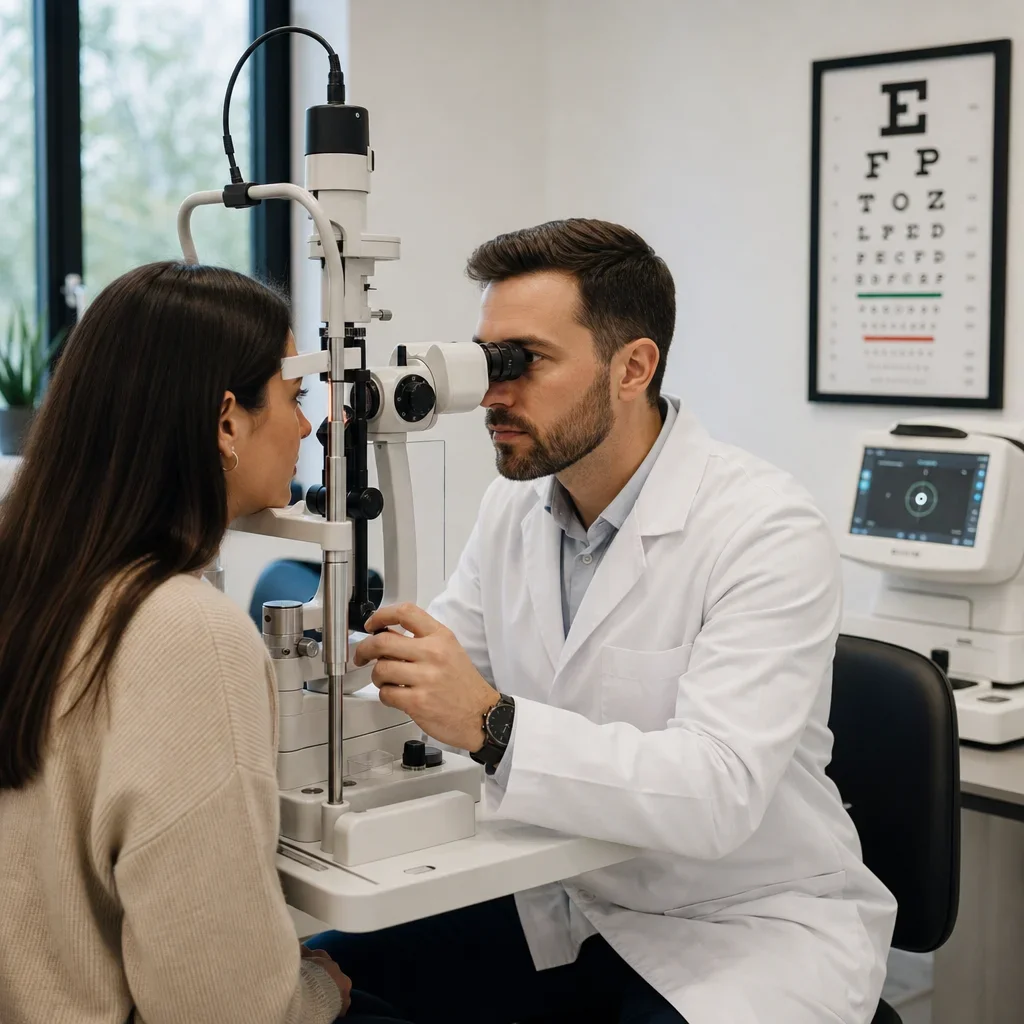
Most comprehensive exams take about 20 to 60 minutes. The range changes with age, symptoms, contact lens needs, whether extra testing is needed, and whether dilation or retinal imaging is recommended.
The visit usually starts with health history and symptom review. We ask about blur, headaches, dryness, flashes, floaters, medications, diabetes, blood pressure, family eye history, and whether you wear glasses or contact lenses.
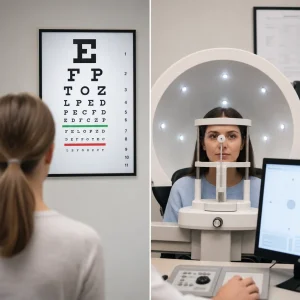
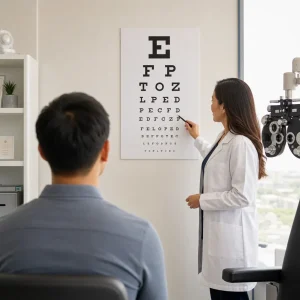
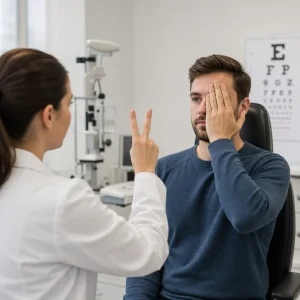
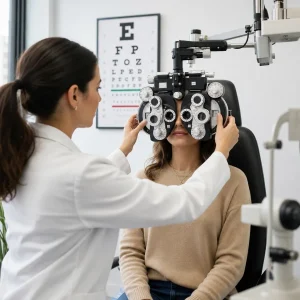
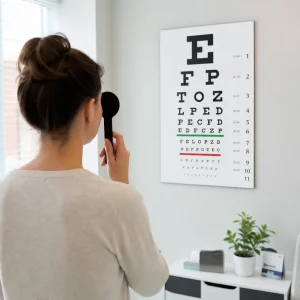
The next step is vision testing. That includes visual acuity, which is the chart test for how clearly each eye sees, and often binocular checks that look at eye movement, focusing, and alignment.
Refraction comes next when glasses are the issue. Refraction is the prescription part of the eye examination procedure. It tells us whether you need single-vision lenses, a stronger reading add, or a change in a progressive lens prescription.
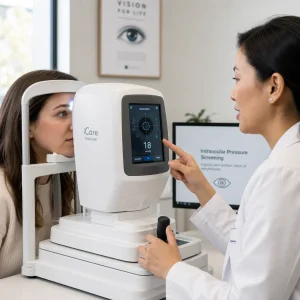
The optometrist may also measure intraocular pressure. That is the fluid pressure inside the eye. Pressure alone does not diagnose glaucoma, but it is one useful part of glaucoma risk assessment.
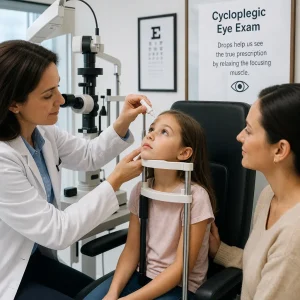
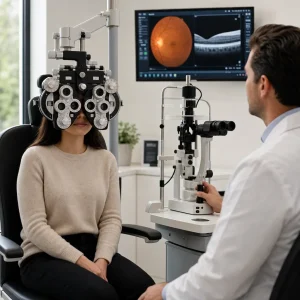
The front of the eye is examined with a slit lamp. That is a microscope with a bright light that lets the doctor assess the eyelids, tear film, cornea, iris, and lens for dryness, irritation, cataract changes, and contact lens complications.
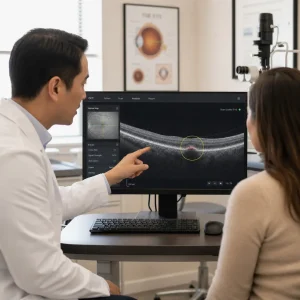
The back of the eye is then evaluated through the pupil. Depending on your needs, that may involve retinal assessment, retinal imaging, dilation, or other clinically indicated testing to look at the optic nerve, macula, and blood vessels.
Not every patient has exactly the same tests each time. Age, symptoms, health history, glaucoma risk, diabetes, and the reason for the visit all change what tests are done during an eye exam.
What Tests Might Be Done During a Comprehensive Eye Exam?
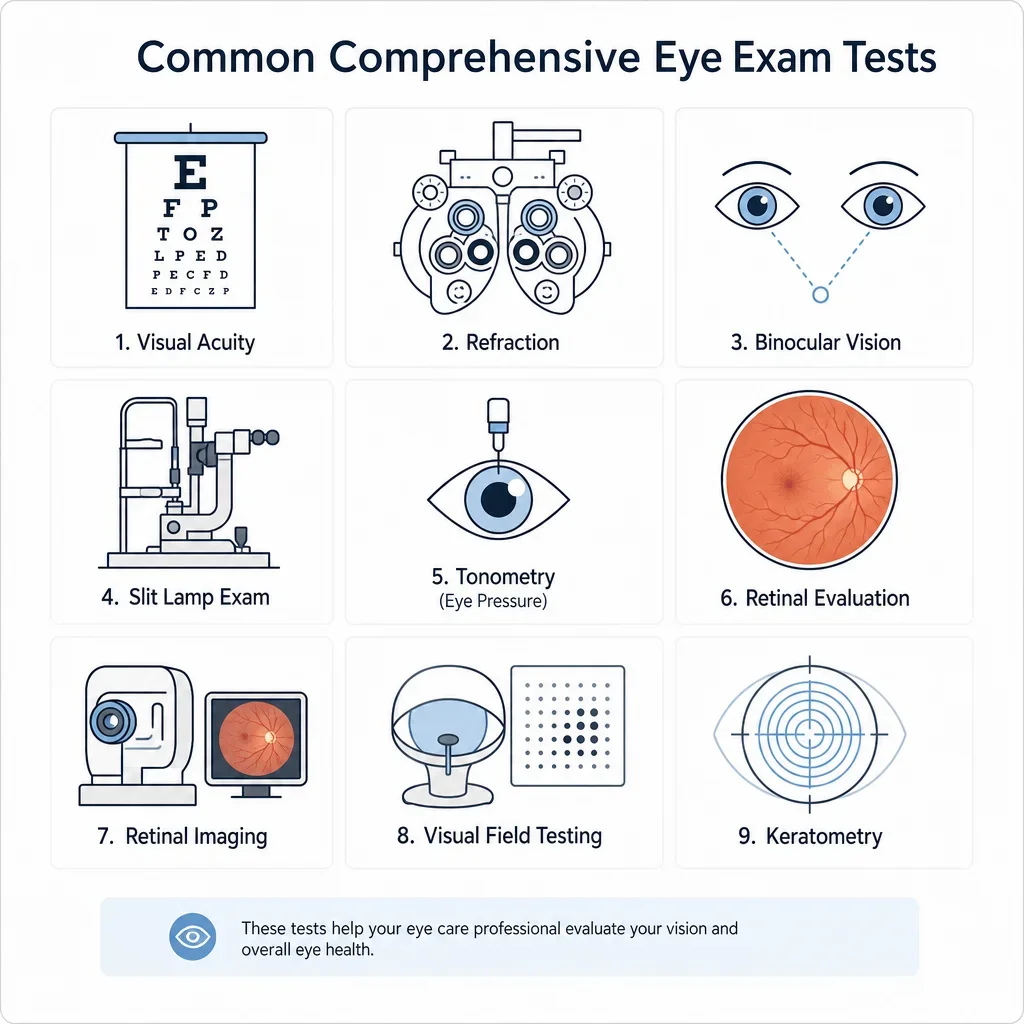
A comprehensive eye examination uses a mix of vision tests and eye health tests. The list below covers common tests, but not every one is routine for every patient.
| Test | What it checks | When it may be used |
|---|---|---|
| Visual acuity | how clearly you see at distance and near | routine for most exams |
| Refraction | the glasses prescription | when updating or checking eyewear |
| Binocular vision testing | eye teaming, tracking, and focusing | headaches, reading strain, children |
| Slit lamp exam | cornea, lens, lids, tear film, front eye health | routine in comprehensive exams |
| Tonometry | intraocular pressure | glaucoma screening and monitoring |
| Retinal evaluation | optic nerve, macula, retina, blood vessels | routine eye health assessment |
| Retinal imaging | documented photos of the retina | baseline records or medical follow-up |
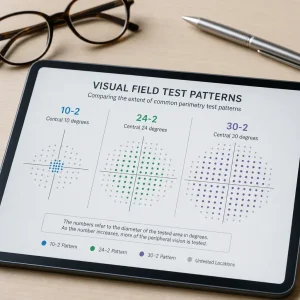
| Visual field testing | side vision and functional field loss | glaucoma risk, neurological concern, disease monitoring |
| Keratometry or corneal measurements | corneal shape | contact lens fittings, astigmatism, specialty needs |
Tonometry is often called the eye pressure test. Visual field testing is more targeted and is not automatically part of every routine eye exam. The same goes for some glaucoma-focused testing, which is usually added when risk factors or findings make it necessary.
Annual Eye Exam vs Vision Screening vs Online Sight Test
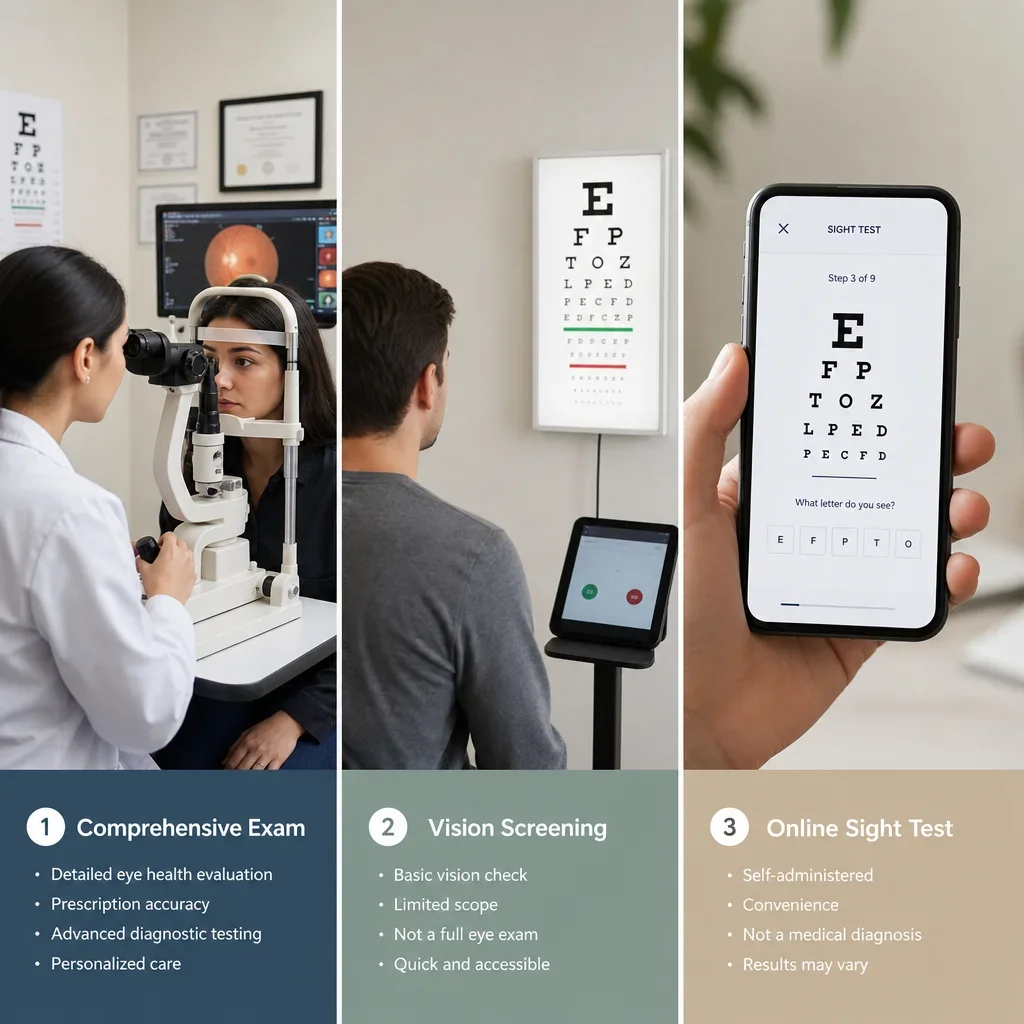
A comprehensive exam is the most complete option because it checks both sight and eye health. A screening or online sight test is narrower and cannot replace a full exam.
| Option | Who performs it | What it can do | What it can miss | Can it replace a comprehensive exam? |
|---|---|---|---|---|
| Comprehensive eye exam | optometrist | checks prescription, eye health, risk factors, and follow-up needs | less likely to miss disease because the exam is broader | no replacement needed |
| Vision screening | school, workplace, public event, some clinics | flags obvious vision issues | eye disease, subtle prescription problems, health findings | no |
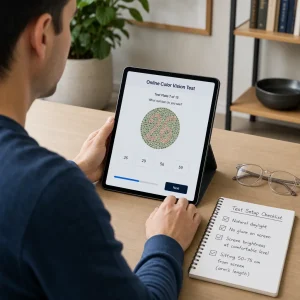
| Online sight test | app or web tool | gives a rough check of visual performance | eye health, accurate refraction, eye disease, fit decisions | no |
| School screening | school program or trained screener | identifies some children who need referral | focusing issues, binocular issues, many eye health problems | no |
A regular eye exam is usually what patients call a comprehensive eye exam. School screenings can be helpful as a filter, but they do not assess the eye as fully and they do not replace an in-person exam with an optometrist.
Who Should Book Sooner Than Their Routine Exam?
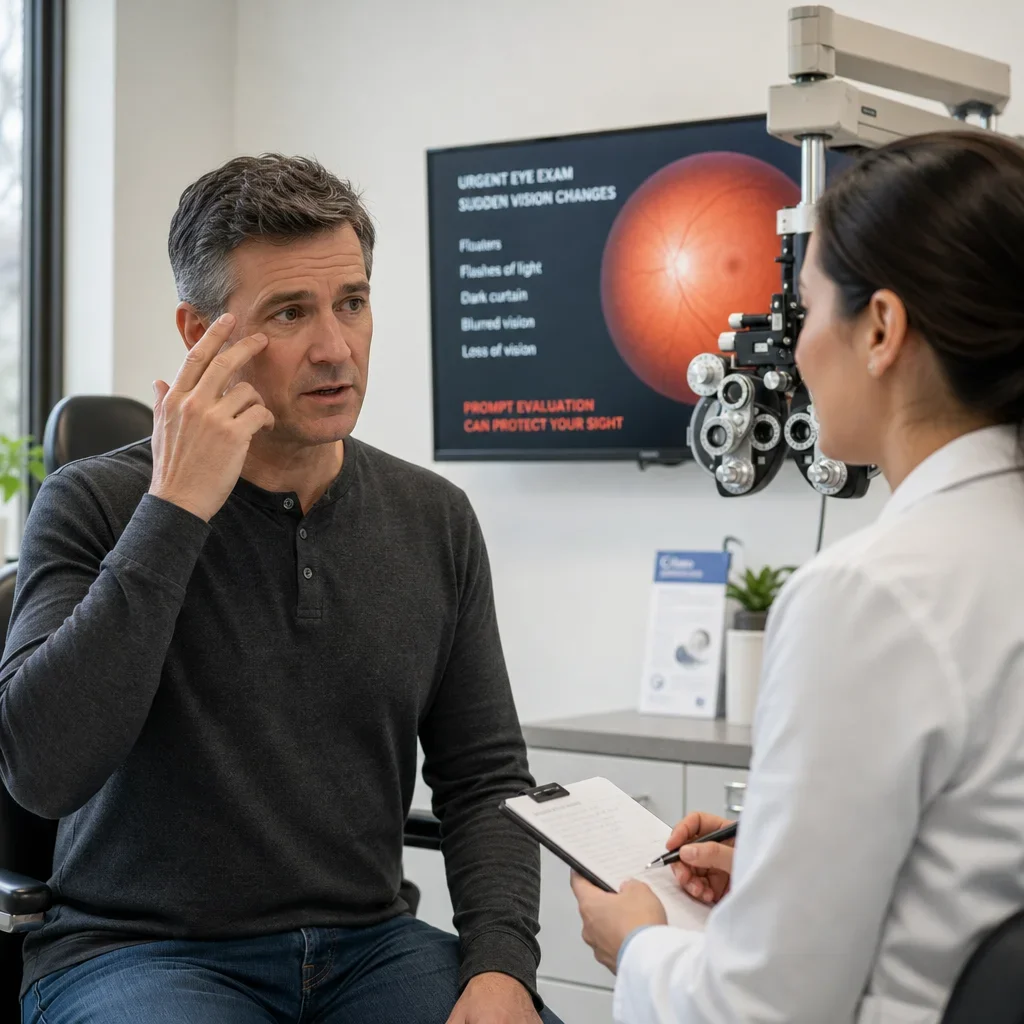
Certain symptoms mean do not wait for your next yearly eye check up. Sudden changes deserve faster attention, and severe symptoms may need urgent medical care the same day.
| Symptom | Possible concern | Timing |
|---|---|---|
| Sudden blurry vision in one eye | retinal, vascular, corneal, or neurological issue | urgent same day |
| Flashes and new floaters | retinal traction or tear | urgent same day |
| Curtain or shadow in vision | possible retinal detachment | emergency now |
| Eye pain with redness | infection, inflammation, angle-closure risk, corneal injury | urgent same day |
| Sudden double vision | neurological or muscle-control issue | urgent same day |
| Peripheral vision loss | glaucoma progression or neurological concern | urgent same day |
| Headaches with vision changes | prescription issue, binocular strain, or medical cause | prompt exam, sooner if severe |
| Contact lens redness or pain | corneal irritation or infection risk | urgent same day |
| Gradual blur or more glare | prescription shift, cataract change, dry eye | book soon |
If symptoms are sudden, severe, or paired with trauma, nausea, weakness, or a major drop in vision, do not treat that like a routine booking. Call for urgent guidance right away.
Risk Factors That Can Mean More Frequent Eye Exams
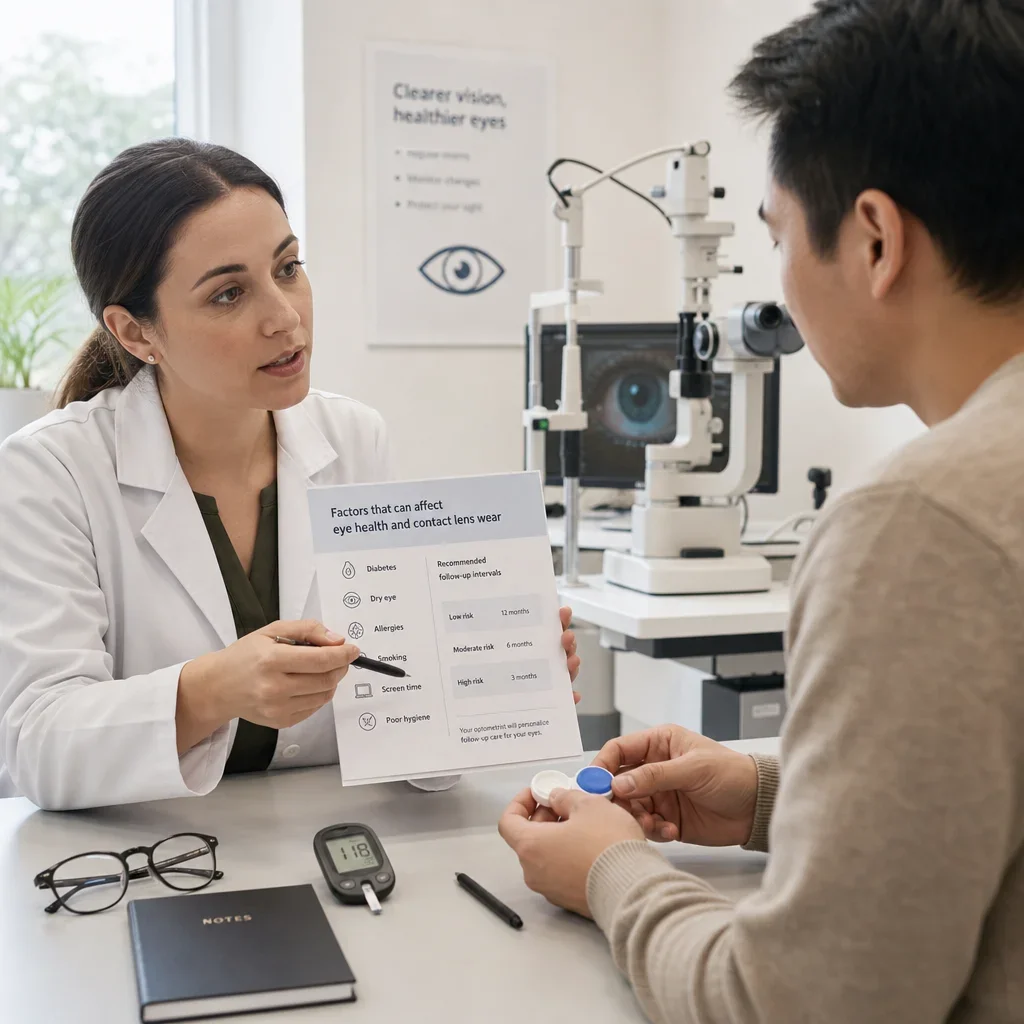
Higher-risk patients are often seen annually or more often if recommended. The most common reasons are diabetes, glaucoma risk, family history, known eye disease, high prescriptions, previous eye injury, prior eye surgery, and contact lens complications.
Contact lens wearers usually need regular follow-up because lens fit, corneal health, tear film quality, and prescription all need review. A contact lens exam is not always the same as a glasses-only visit, especially if the lens type changes or the eyes are dry.
People with diabetes are a separate group because diabetic retinal changes may not affect vision early. A diabetic eye exam may involve closer retinal monitoring than a standard glasses-focused visit, and the optometrist may shorten the recall interval based on findings.
Patients with glaucoma, cataracts, macular degeneration, retinal disease, or strong family history are also not on a one-size-fits-all schedule. Their follow-up is set by condition stability, test results, medications, and how much change has occurred since the last exam.
Heavy screen use can increase strain, dryness, and focusing fatigue, but screen time alone does not automatically mean everyone needs annual exams. Symptoms, prescription demands, and eye health history matter more than hours logged.
Eye Conditions and Health Issues a Comprehensive Exam May Help Detect
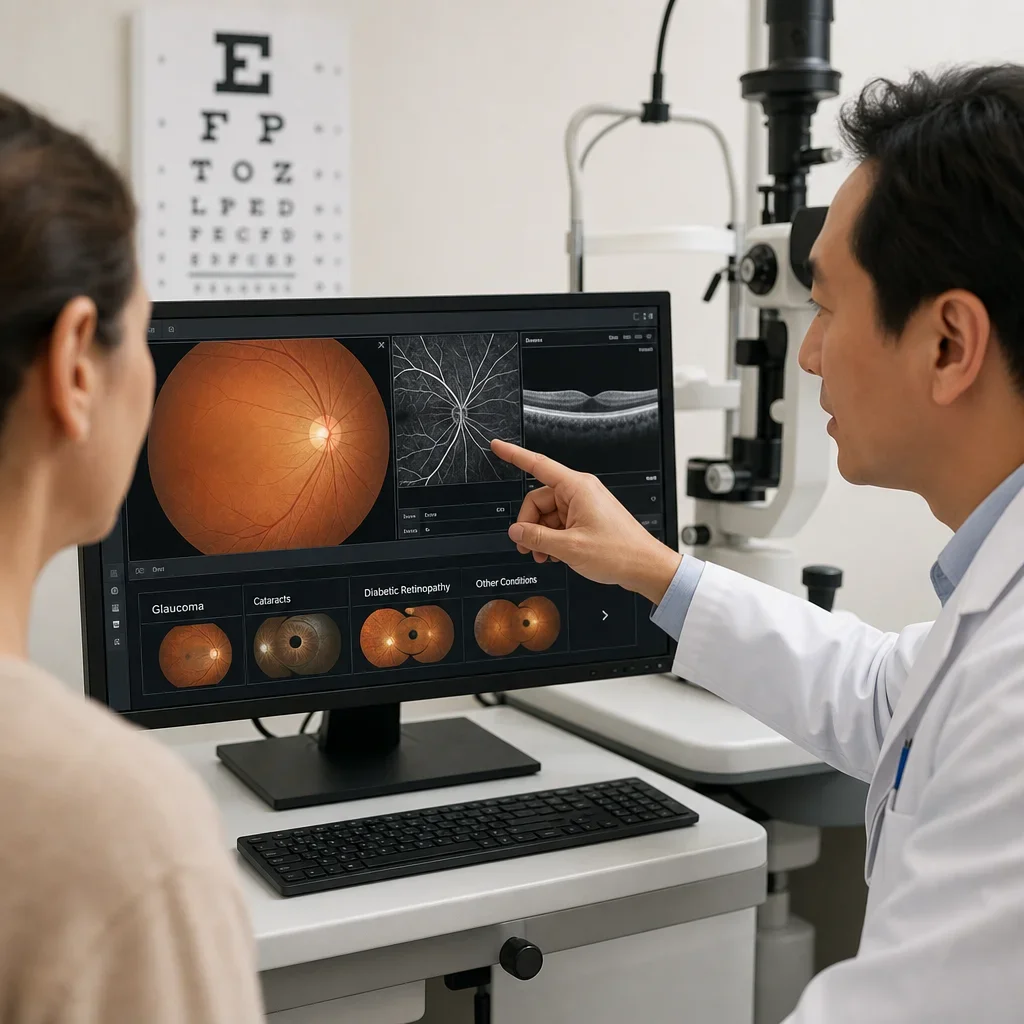
A comprehensive exam may help detect or monitor glaucoma, cataracts, age-related macular degeneration, diabetic retinopathy, retinal holes or tears, dry eye disease, and binocular vision issues. Early glaucoma is a good example because it can progress quietly before a patient notices side-vision loss.
Two signs linked with glaucoma can be raised intraocular pressure and optic nerve changes, but some patients with glaucoma have normal pressure readings at a given visit. That is why glaucoma assessment uses more than one test and more than one appointment when needed.
An exam may also reveal retinal or blood vessel changes that suggest diabetes, high blood pressure, or high cholesterol. In that case, the eye doctor may recommend follow-up with your family physician for medical testing rather than assuming an eye exam alone gives the full diagnosis.
High blood pressure can affect the eyes and may contribute to blurry vision in one eye in some cases, but blurry vision has many possible causes. Sudden one-eye blur should be assessed promptly rather than self-diagnosed.
Ontario Coverage: OHIP, Private Insurance, and Who May Be Covered
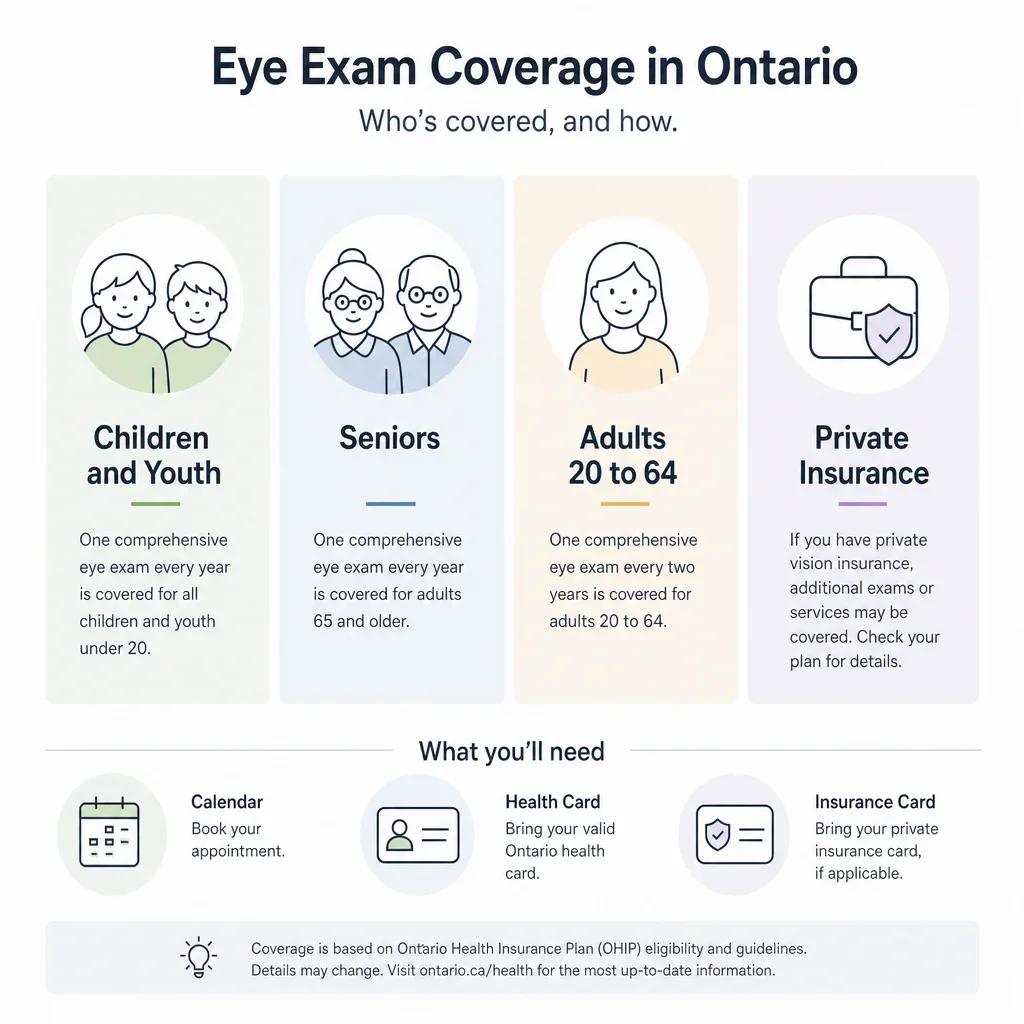
In Ontario, OHIP coverage for eye exams depends on age and certain medical conditions, and those rules can change. We always tell patients to verify current eligibility through OHIP or ask us to check what applies to their situation.
For children and youth 19 and under, insured routine eye exams are generally covered once every 12 months, plus any follow-up care that is medically necessary. For adults 65 and older, insured routine exams are generally covered once every 18 months if they do not have specified high-risk conditions, with additional insured visits possible for certain medical reasons.
For adults 20 to 64, routine comprehensive exams are usually not covered by OHIP unless the patient has an eligible medical condition defined by Ontario. Those medical categories and visit limits are accuracy-sensitive, so we recommend checking the current Ontario Ministry of Health guidance or asking us to review your eligibility before the visit.
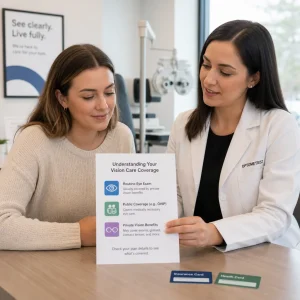
Private workplace or individual vision plans may cover all or part of an annual eye exam cost, and some plans also contribute to glasses or contact lenses. We can direct-bill many insurers, but exact exam coverage depends on your plan, renewal date, and whether your benefits separate exams from eyewear.
If you are searching how many free eye tests can I have in a year, the answer is not one fixed number for everyone. It depends on age, OHIP eligibility, medical condition, and whether a follow-up is medically necessary.
How Much Does an Eye Checkup Cost Without Insurance?
In Ontario, a comprehensive eye exam cost without insurance commonly falls in the broad range of about $100 to $250. The range shifts based on clinic, city, patient age, exam complexity, contact lens assessment, and whether extra testing is added.
A regular eye check up cost can be lower for a straightforward routine visit and higher for specialized care. Contact lens fittings, medical follow-up testing, pediatric assessments, and some imaging services may be separate from the base exam fee.
We would need to see the reason for your visit to say for sure. That is the honest answer. An annual eye exam cost for a glasses update is not always the same as a contact lens evaluation or disease-monitoring visit.
If you have insurance, the out-of-pocket amount may be anywhere from $0 to the full private fee. That depends on your plan maximum, deductible, and whether the exam date falls inside your benefit period.
How to Prepare for Your Eye Exam
Bringing the right items makes the visit smoother and usually shortens delays at check-in. Bring your current glasses, contact lenses and case, medication list, health card, insurance details, and any previous prescription you have.
Write down symptoms before the visit, especially when they started, whether they affect one eye or both, and what makes them worse. That small step often helps the optometrist decide faster whether the issue sounds refractive, dry-eye related, binocular, or medical.
If dilation may be used, light sensitivity and near blur can last for several hours. Bringing sunglasses is smart, and if you know you are sensitive after dilation, arrange your day so you are not rushed.
Contact lens wearers should ask what to do before the appointment because the answer depends on the purpose of the visit. For some contact lens assessments, wearing the lenses in is helpful. For other visits, removing them in advance gives a clearer view of the cornea.
Do not hide symptoms, and do not assume a school screening or online sight test is enough. If your vision feels unsafe after dilation, do not drive until it clears.
What If You Need Glasses After the Exam?
If your prescription changed, the next steps are usually lens selection, frame fitting, PD measurement, and dispensing. PD means pupillary distance, which is the distance between your pupils and one of the key measurements that helps centre lenses properly.
This is where a glasses exam and a full optical shop work best together. After the optometrist finishes the exam, we can explain whether you need single-vision lenses, a progressive lens for distance and reading in one lens, blue-light discussions only if they fit your use, photochromic lenses that darken outdoors, or an anti-reflective coating that cuts glare from screens and night driving.
Fit matters as much as prescription. We adjust the frame, check how it sits on the bridge and ears, and match lens options to your work, driving, computer use, reading distance, and budget.
At our Waterloo clinic, patients can move from exam room to frame selection in one visit. Because we also cut and coat lenses on-site for eligible jobs, some prescriptions are ready much faster than work sent out, while higher prescriptions and specialty coatings are quoted separately.
FAQ
Do I really need an eye test every year?
Not always. Lower-risk adults are often seen every 1 to 2 years, while children, seniors, contact lens wearers, and patients with diabetes or eye disease are often seen yearly or more often if advised.
What is an annual eye check-up?
It is usually a comprehensive eye exam that checks vision, prescription, and eye health. It is more thorough than a quick screening or online sight test.
Should eyes be checked yearly?
Some should. Children, many seniors, contact lens wearers, and higher-risk patients often benefit from yearly care.
What happens during a yearly eye exam?
Most visits include history, symptom review, visual acuity, refraction, eye pressure or other appropriate testing, slit lamp assessment, retinal evaluation, and a results discussion. The exact mix changes by age, symptoms, and risk.
What tests are done during an eye exam?
Common tests include visual acuity, refraction, binocular vision checks, slit lamp exam, tonometry, and retinal assessment. Visual field testing, imaging, or other measurements may be added when clinically indicated.
Does a vision screening replace a comprehensive eye exam?
No. A screening can flag a problem, but it does not replace a comprehensive exam with an optometrist.
Do people with 20/20 vision still need eye exams?
Yes. Clear sight does not rule out glaucoma, retinal disease, cataracts, or early health changes in the eyes.
Do contact lens wearers need more frequent eye exams?
Often yes. Contact lens wear affects the cornea and tear film, so fit and eye health should be reviewed regularly.
Do people with diabetes need annual eye exams?
They often need at least annual care, and some need closer follow-up. The optometrist sets the interval based on findings and medical history.
Is there a difference between a regular eye exam and a diabetic eye exam?
Yes. A diabetic visit may involve closer retinal monitoring and more medically focused follow-up than a routine glasses update.
How long does an eye exam take?
A typical exam takes about 20 to 60 minutes. Extra testing, dilation, or contact lens work can lengthen the visit.
Should I get my eyes dilated during an exam?
Sometimes. Dilation helps the optometrist see more of the retina, but it is not necessary in every case. The doctor recommends it based on age, symptoms, risk, and what needs to be assessed.
What should you not do before an eye exam?
Do not leave out symptoms, do not assume a screening was enough, and do not ignore instructions about contact lenses. If dilation is planned, avoid booking a schedule that depends on perfectly clear near vision right after.
How much is an eye checkup in Ontario?
Private-pay comprehensive eye exams often fall around $100 to $250, but the reason for the visit can move that range.
Does OHIP cover eye exams in Ontario?
Sometimes. Coverage depends on age and certain medical conditions. We recommend checking current OHIP rules or asking us to review your eligibility.
How many free eye tests can I have in a year?
There is no one answer for everyone. The number depends on OHIP eligibility, age, medical need, and whether the visit is routine or a medically necessary follow-up.
Can an eye exam show high cholesterol?
It can sometimes show eye findings that raise suspicion, but it does not confirm high cholesterol by itself. Medical testing through your physician is still needed.
Can someone with dementia have an eye test?
Often yes. The exam may need to be adapted, shortened, or broken into simpler steps, but many patients with dementia can still have useful vision and eye health assessment.
If you are in Waterloo or Kitchener and you are not sure whether you need an annual eye test, every-2-years care, or something sooner, the best next step is simple. Book a comprehensive eye exam, or call with your age, symptoms, and coverage questions, and we can help you sort out the right timing.